A lot. Years ago I deliniated a time every day to stop everything else and read. I decided that, at 9 p.m., unless engrossed in something endlessly fascinating, I’d head to the arms of my current read. And I’ve been faithful.
The problem is no matter how much I read I’ve discovered a good book is hard to find. I rarely leave them, but I recently walked out on one mid-paragraph. I could stand it no longer! I even flung it across the room, and it by a celebrated author! So here’s only my second post on a really good book I truly loved. It is the only book I’ve ever read that, as soon as I finished, I wanted to begin again.
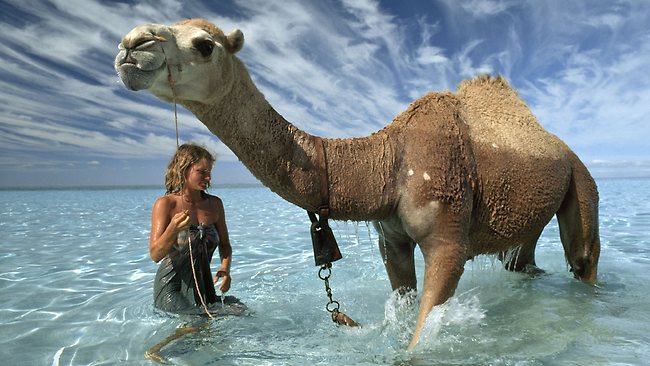
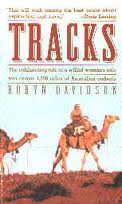
In 1977 a young woman in her 20s, Robyn Davidson, led and rode her four camels from Alice Springs, Austrailia west to the ocean. National Geographic funded her (a whopping $4000), and she wrote a story for them published in 1978. It took her nine months to travel the 1,700 miles. Although it wasn’t her original intent, she wrote a book on the trip called Tracks.
I know you’re thinking, “Oh, well, of course you liked it. You tried something similar. But I probably won’t find it interesting.” Okay, fair enough. I admit I found her mixed feelings about the trip extremely validating, and her experiences similar–even though my trip was short lived. But the book is very well written, engaging, and NOT WOOWOO! I have become tired of writers involking god or spirituality or some outside power as explanation of certain states. I found Robyn’s take on such experiences refreshing. Here’s a sample:
“…I now had enough to provide a structure in which I could learn to learn. A new plant would appear and I would recognize it immediately because I could perceive its association with other plants and animals in the over all pattern, its place. I would recognize and know the plant without naming it or studying it away from its environment. What was once a thng that merely existed became something that everything else acted upon and had a relationship with and vice versa. In picking up a rock I could no longer simply say, ‘This is a rock,’ I could now say, ‘This is part of a net,’ or closer, ‘This, which everything acts upon, acts.’ When this way of thinking became ordinary for me, I too became lost in the net and the boundaires of myself stretched out for ever. In the beginning I had known at some level that this could happen. It had frightened me then. I had seen it as a chaotic principle and I fought it tooth and nail. I had given myself the structures of habit and routine with which to fortify myself and these were very necessary at the time. Because if you are fragmented and uncertain it is terrifying to find the boundaries of yourself melt. Survival in a desert, then requires that you lose this fragmentation, and fast. It is not a mystical experience, or rather, it is dangerous to attach these sorts of words to it. They are too hackneyed and prone to misinterpretation. It is something that happens, that’s all. Cause and effect.”
Below are my thoughts and answers to questions posed by Utah State graduate student Tori Edwards on southern Utahand Rockville’s sense of place and history of human/landscape interaction. Would love to hear your thoughts and comments.
Tori Edwards: I’ve been intrigued with the idea that the pioneers who settled Springdale andRockville didn’t appreciate the beauty of the landscape around them, and I’m trying to figure out where this idea came from. I know that the area was very difficult to derive sustenance from, as evidenced by journal entries from early settlers in St. George. I also know that there was some resentment among the early settlers when Zion was established as a National Park, so I’m wondering if the idea originated around this time.
Greer: That is a big topic! One of the initial reasons for the PioneerVoices Project was to discover if there was a link between early settlers and Zion’s natural environment. Each interview followed the same format, and most questions were about memories of “nature” interactions. The people I interviewed did not recount strong “nature” associations except Evan Cox who seems to be one of those people who feels connected to nature. Although the project’s original intent was to find and expose pioneer nature associations, so little was found that the final book changed to recounting memories of lifeways and family.
I think some of the dichotomy you’re investigating comes from individual differences. People originally came here for a different purpose than they come now. Zion now attracts people 1) who come to tick off another scenic view/American Icon, etc., or 2) have a personal connection with “nature.” The people who came in the 1800s were 1) sent whether they wanted to come or not, or 2) were looking for some place to make a living. The mindset was very, very different. Though things were not as desperate as often portrayed, things were critical (this was not the horrible harsh desert vs. man, but the land still had to provide). A flashflood, a summer without rain, etc., were life-defining. I don’t think, for the most part, from the talks I’ve had with folks, that the area’s beauty was paramount. I think they noticed, I think they appreciated, but I don’t think, unless they had that special nature connection, that they felt what many coming now might feel. Just like in any modern community anywhere—some people connect to the land, others don’t. I did not get the impression Mormonism conveyed land management precepts (and that was a questionnaire question). When all one’s food and livelihood comes from the land, I believe people will do almost anything without regard for what problems it might cause to the “environment,” or even to their own livelihood in ten years.
In the research I did for the Grand Staircase—Escalante book, I found an interesting dichotomy between ranchers interviewed in the 1930s and their modern descendants. At least ONE rancher interviewed in the 30s (WPA, etc.) stated in detail how he realized cattle had destroyed the land. He recounted how his predecessors had found tall, lush grass covering the “desert,” and how without knowledge or seeming concern, they had systematically grazed everything beyond recovery. This may have been because settlers were not familiar with the desert’s fragility. He felt responsible and felt the entire area should be made a national park as it was beautiful and now mostly unusable for much else. (The Escalante area was horribly destitute in that time; it’s amazing people survived there at all).
What I witnessed in Southern Utah when I arrived in the 1980s (and still see vestiges of today) was a total defense of past practices by men who inherited them, regardless of any refuting science. This was saddening as it seemed better land management practices could improve the degradation, and thus, husbandry. But what prevailed was a staunch, unrelenting defense of a total way of life which may have been bolstered by feelings of an assault on community, faith, lifeway, etc. That was when acts of willing destruction of wilderness values and “nature” occurred regularly, and which can still be seen in the strong reaction to environmental groups, restrictions, legal challenges, etc.
By the mid-1900s, I think people also began to realize they could make a living from visitors. I don’t see where that made them more inclined to bask in or preserve the area’s beauty, i.e., no one proposed more preservation, but more development. In researching a Bryce book, I discovered that initially, there was support for creating national parks in Utah from Utahans, but that quickly reversed. There was a fight to create every park in Utah even in the early 1900s. There has long been a sense of “it’s OURS” here, and potential loss doesn’t seem to revolve around destruction of what’s natural, but around loss of potential use. Notice that MOST of those who fought for park establishment (not just here) were not from here. It was often the amazement of new eyes that fueled park creation. It may have been something as simple as long-term habituation that dulled the area’s amazement to inhabitants, and certainly to those born here and for whom a week-long wagon trip to St. George was a looooonnng way. They didn’t really know the rest of the world didn’t look like this!
As to your specific questions:
Tori: “The question is about the pioneers who settled Southern Utah, and their attitudes regarding the environment. I’ve been intrigued with the idea that the pioneers who settled Springdale and Rockville didn’t appreciate the beauty of the landscape around them, and I’m trying to figure out where this idea came from. I know that the area was very difficult to derive sustenance from, as evidenced by journal entries from early settlers in St. George. I also know that there was some resentment among the early settlers when Zion was established as a National Park, so I’m wondering if the idea originated around this time. But there are also conflicting ideas I’m trying to figure out: 1) The early pioneers settled the area with the principle of stewardship ingrained into their minds–to take care of the land they were given.”
Greer: From the interviews done on the Pioneer Voices project, I do not believe this to be true, as I’ve stated in more detail above. That was one of the goals of the project, and you might want to scan the interviews to see if I’m misrepresenting this, but as I recall, when asked, people stated there was no land-management guidance from the church. Biological evidence from all over Utah certainly supports the claim that the land was used as much as possible, probably changing it forever.
Tori: “2) The descendants of those early pioneers defend their ancestors, saying they did appreciate the beauty of the area, as evidenced in Pioneer Voices of Zion Canyon.”
Greer: I think again, you are looking at two overlapping ideas: appreciation and preservation. As we know, one can appreciation something and still destroy it. I appreciate an ice cream cone, and now I’m going to eat it! We cannot really know what someone thought, the feelings they had unless they express them in some way. For example, they wrote it down, they said it aloud, they made art of it, they created a monument, etc. So the pioneers may have “appreciated the area’s beauty,” but unless they physically expressed that in some way, we cannot know. One way they might have expressed it was by setting aside a “do not use” area. As far as we know, they did not. But then, it would have been astonishing if they had. If you study the national park idea you’ll realize that Zion was one of the first areas set aside under this “new idea” of national parks. I did a program for the Chicago Humanities Program a couple years back—and Ken Burns has done a similar program on America’s Best Idea—national parks. So the folks in Zion in 1909, when Mukuntuweap was set aside as a monument, had NO IDEA what was going on. The NPS wasn’t even created until 1916; what was this national monument thing?? What it was, was CHANGE, that awful beast, and regulation in a largely unregulated area. You must remember that everyone interviewed from then on looks back from a perspective of knowing what national parks are, what they’re for, and what they represent (both ideologically and financially!). Everyone who has lived here since 1909 or thereabouts has benefitted financially from the park, whether it’s in direct payment for services or in something as seemingly intangible as perpetually high property values.
Tori: “Also, Stephen Mather, who helped establish Zion as a national park, reported that the people who lived there at the time were good to work with, and generally cooperative. If there was animosity, and if Mather believed the settlers didn’t appreciate the beauty of the land, I would think he would have stated so.”
Greer: I don’t. One must consider the source: Mather was an extremely successful business man, a political animal, and a consummate public relations expert. He would not have said otherwise. In that year, he was trying to gain support not only for this park, but the National Park Service and every other national park being created then or in the future, and for unpopular regulations being implemented. This was part of a much larger and more important movement then only just getting started. He had to make the case for this park locally AND nationally. This went, as these things still do, waaaaay beyond the local.
Tori: “Yet, it seems to make the most sense that the idea of the settlers not appreciating the beauty of the area would have originated around the time of the Park being established. The reason I say this is because of a quote in Pioneer Voices (p. 83):
“There was an erroneous rumor that went around for years. You used to hear that ‘the natives, they don’t appreciate the park, we’ve got to get in there and preserve it so they don’t destroy it. They want places to farm, they don’t want a park to look at.'”
Greer: Well, there’s always truths in statements like this, aren’t there? Which truths? There is the truth in the original statement, that people did resent the park, they did want places to farm (remember, it was a totally different economy then), they didn’t see the value in this new-fangled park thing, whatever it was (they had NEVER been to or heard of a national park!). And then there is truth in the idea that some people didn’t have that view. Look up esp. J.L. Crawford’s interview. His mother (grandmother?) sold the farm to the park and moved; J.L. says she both resented (losing the trees she’d planted and nursed all those years) and understood it. And there is truth in a descendant stating previous versions of the story are flawed, “My ancestors did too see the beauty! They weren’t heathens!” (i.e., and thus, neither am I).
I’m unsure your question is the right question, or that there is an answer. I think what we can say with some confidence is that reactions and interactions with “nature” are hugely complex and certainly intertwined. We, as humans with feelings and as animals trying to survive, have intense and often opposed needs from the same plot of land. These needs shift over both long and short time periods: from physical sustenance to the comfort of a known place, a “home,” to a need for adventure and a foe to test oneself against, to the crucible of a nature spirituality and personal regeneration, and not insignificantly, a biotic sanctuary for the other-than-human and a gene pool for the future. A lot of demands from one little landscape!
One last tiny clarification, I do not think the destruction of southern Utah’s natural environment was wanton, but rather an unintended consequence.
The following was published in The Joy of Rockville, a cookbook created to celebrate Rockville’s Sesquicentennial (150 years) in 2012:
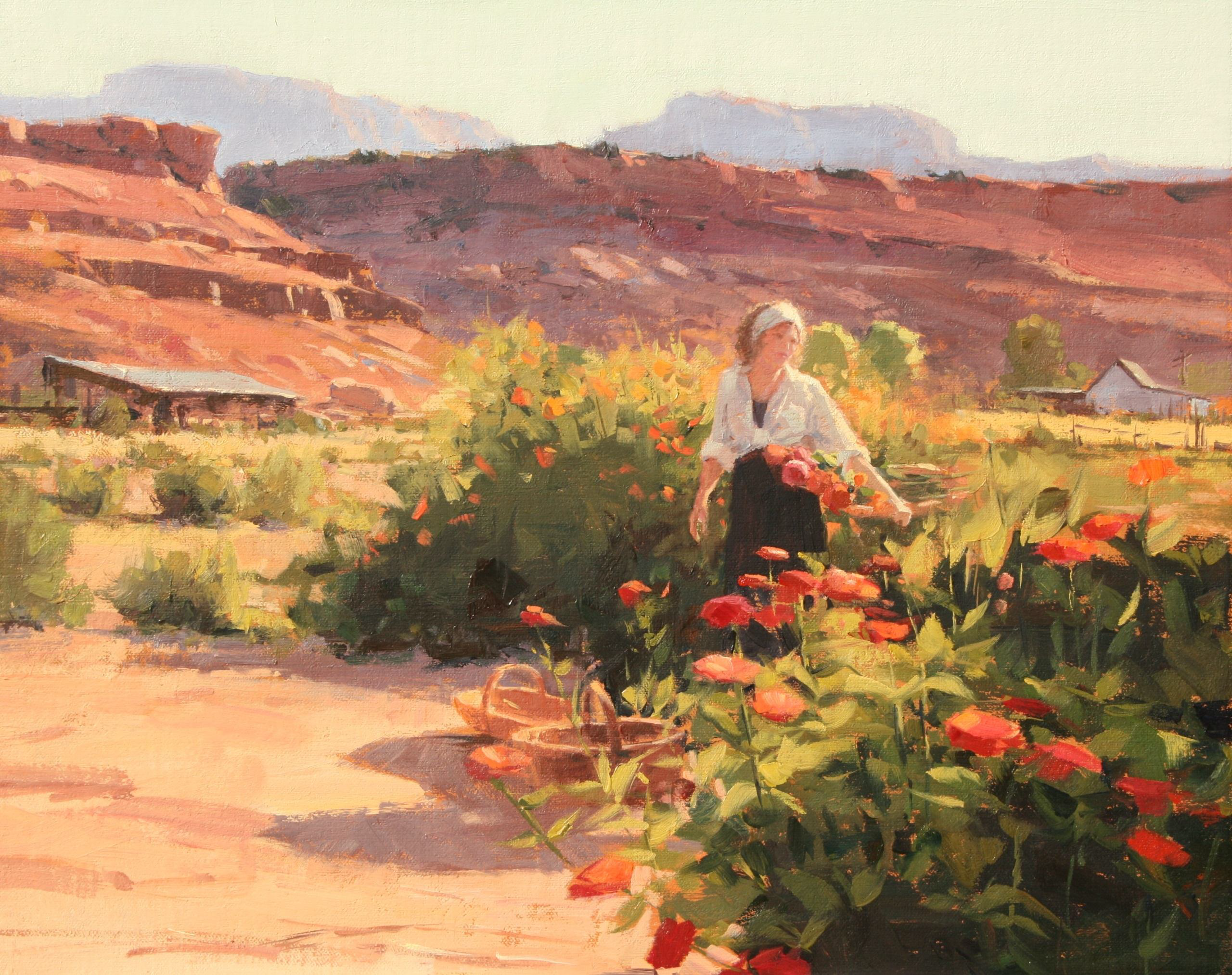
Kate Starlings’ fabulous cover painting is, to me, the essence of Rockville. Living in our small town may not always be the easy, temperate, and peaceful life Kate’s image evokes, but Rockville can be that, and more. No matter what may be happening, I’m always glad to waken under Rockville’s azure skies and redrock embrace. In this year of little rain, I’m even happier to see rare skies, the color of a kingfisher’s wing, bringing a “three-inch rain.” When the cloud fleet sails the sky, I know it’s July; when burnt umber cottonwoods crisp the day, and that rare sunset glow lingers on cliffs, I know I’m home. I imagine, though we rarely read it in histories, Rockville’s early settlers felt the same. Hearing the Virgin River rush over rock; wading stone irrigation ditches on a scorching afternoon; eating ripe mulberries full of purple; soaking in star-glow on a dark summer’s night, meant the same to pioneer and current neighbor alike: home.
Rockville changed over its first 150 years, as, thankfully, it has remained the same. Kate’s artwork could have been painted in 1862 or 2012. The canyon’s cliffs remain, and they transform. The Virgin brings nurture and devastation. Some of us are old timers, tracing family lines back to our town’s founding; some are what our much-missed Fern Crawford called “middle timers”; some are just discovering Rockville’s special wonder. But no matter our origin, all of us—long past or newly arrived—write another line in the ongoing story that is Rockville.
The Virgin Anasazi, Southern Paiute, and those even more distant, told stories of our shared home we will never hear. Sooner than we know, the future’s unnamed will come seeking a home and story of which we can only dream. May they find the community, beauty, and abundance all those before them found in this green and lovely place called Rockville.
I note by my last post’s date than I’m a tad out of date, or perhaps out of time, in the sense that half a year trundled past and I hardly noticed. I also note mid-June was about the time my life changed–again–and I suppose I’ve spent the intervening seven months grieving the old and accepting the new. As Nando Parrado says, “There are rules and realities that will not change to suit your needs” (see the Cannibalism post). Damn.
I’m hoping to be a tad more occasional (does that mean I’ll post more often or less?) with the blog and, to finish, finally, my last post, I include the second fabulous postcard, from Utah State graduate student Tori Edwards, below. What a delightful young woman! I had been talking, if you recall, about postcards from the unknown. About how writing can have influence and meaning beyond what we intend while sitting at our desks in the middle of nowhere and the midst of everything.
“Hi Greer,
“I’m the Utah State grad student who contacted you about an interview for my thesis. I’m getting a better idea of Rockville’s sense of place and of community. What started my research was your statement in Zion Canyon: A Storied Land:
I can only acquaint you with the conversation I’ve been having with this place for the last twenty years or so, and I can only use the language I have, inadequate though it may be. I carry a slight accent. Those from here can tell I’m not, but they can also tell that after all these years, I am now of here” (p. 9).
“I’ve been so intrigued by that statement, “I am now of here.” My research in Rockville has been trying to come up with the answer to the question, What does it mean to be of somewhere? And more specifically, What does it mean to be of Rockville? In reading Wallace Stegner and Terry Tempest Williams, I’ve come to better understand what a sense of place is, and what meaning people attach to living in the desert. Rockville has been a wonderful place to discover sense of place, especially where it’s faced with so many things like traffic and crowds of people moving through to visit Zion. I’ve been intrigued by how Rockville manages to keep its sense of a rural community in the face of such challenges.”
It always amazes me when something I’ve written sends a postcard home. This week, I found two such postcards rattling about in my empty post box. Writing is an odd craft, done in silence and alone. Once one shepherds a piece out the door, one rarely or more likely, never hears from it again. It’s an amazement then, when words lying flat in a closed book, suddenly, when the spine is cracked, pierce a neuron in another brain far removed in time and space. Somewhere, another mind is sparked, and a new creation leapfrogs into being. I am deeply honored to have even the slightest influence on these new creations.
An excerpt from Stephan Legault’s latest book’s acknowledgements: “I wish to thank Greer Chesher for introducing me both to the ecology of the American Southwest, and to the mystery genre, when I worked for her as a volunteer at Grand Canyon National Park in 1993–94. Greer also read early drafts of my never-to-be-published attempts at fiction and gently pointed out that these stories would benefit from a plot.”
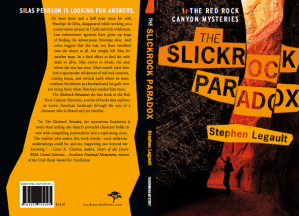
That really cracked me up. I did say that, and Stephan actually took my advice! I read the book though it isn’t available until September (I got to be the Lone Blurber!). And it’s good! It has a complex plot that keeps you turning pages. Be sure to get a copy when it comes out–especially if you like the desert southwest. Here’s my blurb:
In The Slickrock Paradox, the mysterious Southwest is much more than setting; the desert’s fully drawn character holds its own with the book’s compelling personalities and captivating story. The realistic plot makes the book timely—such nefarious undertakings could be, and are, happening just beyond our knowing. Greer K. Chesher, Author, Heart of the Desert Wild: Grand Staircase—Escalante National Monument, winner of the Utah Book Award for Nonfiction
and an excerpt from Steph’s blog about the book:
Countdown to release of The Slickrock Paradox
In a few short months The Slickrock Paradox will be released by TouchWood Editions. Set in the American Southwest, Slickrock tells the story of Silas Pearson, an English professor searching for his missing wife among canyon country’s monuments, grottos, and reefs. Penelope vanished more than three years before while working on a clandestine conservation project to protect what she called “Ed Abbey Country.” She went backpacking near Moab, Utah, and never returned. Now Silas is searching every corner of the great American desert trying to find her. When he discovers a body in a remote corner of Arches National Park he thinks his search is over, but it’s only just begun.
The Slickrock Paradox is the first in a series of novels inspired by the iconic landscape of the Arches, Canyonlands, Grand Canyon, and Escalante regions of Utah and Arizona, as well as my life-long love of the hard-boiled writing of Edward Abbey. Black Sun Descending and The Same River Twice will be published in 2014 and 2015.
Another fabulous artist/scientist/creative group: Colorado Art Ranch. I attended their seminar on Food (see photo above and yes Peter, even though I don’t cook) in Cedaredge, Colorado. Fabulous. Their MISSION, should you choose to accept it:
Many of us are looking for ways to understand and address previously unimagined challenges in the world. Colorado Art Ranch believes that the arts, in collaboration with the sciences, can help solve contemporary land and social issues. Our organization strives to nurture the development of literary, visual, and performing artists who ask difficult questions through their work; stimulate interdisciplinary collaborations that help envision solutions; and build creative capital in rural communities.
As someone interested in both science and creativity, I love this website and get their weekly newsletter. It’s my Sunday morning newspaper. Take a look: brainpickings.org. This is the website/blog I’d love to be writing!!
Click on the image to go to the University of Michigan’s LSA Magazine’s article on cannibalism.
“In the first hours there was nothing, no fear or sadness, no sense of the passage of time, not even the glimmer of a thought or a memory, just a black and perfect silence.”
Recently, perusing my university’s alumni magazine (The University of Michigan’s LSA Magazine) I was amused to find, amid The Food Issue’s expected articles on famous chefs, farmer’s markets, food research, and the neuroscience of eating—all concerning U of M students, alumni, and professors—an article on a professor researching cannibalism (click on the image above to go to the original article). Two things drew me head first into the article, 1) the editor’s twisted sense of humor, which I readily applaud, and 2) the article’s iconic photograph (below).
On December 23, 1972, the last of 16 survivors from Uruguayan Air Force Flight 571 were rescued in the Andes Mountains. Their ordeal and subsequent cannibalism were the basis for the 1993 movieAlive.
In the article, Dr. Peggy McCracken discusses famous cannibalism cases including the Donner Party, Jeffrey Dahmer, and, if you were alive in 1972 you will remember, the famous Andes crash of the plane carrying the Uruguayan rugby team. Sixteen of the original 55 or so passengers and crew survived two-and-a-half months in frigid, impossible conditions by consuming those who didn’t survive. The story was made into a book and movie (Alive!); the rescue was a world-wide astonishment. I was 18 at the time, and wanted to read the book, but never got around to it. When I saw the article and photo, I felt it was time. I quickly downloaded to my Kindle the only book listed on Amazon, and am I lucky I did. The book, Miracle in the Andes: 72 Days on the Mountain and My Long Trek Home, by Nando Parrado and Vince Rause, was published only recently, in 2006, and is by a survivor (Parrado) and New York Times writer (Rause). It is an amazing book. Although Alive! documented what happened, Parrado relates, in incredibly compelling prose, how he survived, how he thought and felt during the ordeal, and how now, as a 60-year-old man, he feels about what happened almost 40 years ago.
I have never felt as present in a book as I did in this one. Parrado makes you feel the horror, the day-to-day terror, the hunger, thirst, and desperate COLD. The excruciatingly slow passage of time, coupled with continuing deaths from injuries sustained in the crash, and the realization rescue is not coming is enough to drive people insane, but due to the men’s caring for each other, it doesn’t happen. Finally, after two months, Parrado and a companion scrabble and claw their way through the snow-packed Andes and down a river-filled canyon to find a lone horseman heading cattle. He hears their story and takes off—leaving them to wonder where he’s gone—until rescue appears 12 hours later. The shepherd—an elderly man–had ridden ten hours straight to the nearest outpost.
Parrado tells the story of his last day of “real” food: one chocolate-covered peanut. The day he received it he slowly sucks off the chocolate. The next day he divides the peanut in half along the seam and eats half. The last day, he eats the second half. Can you spell e-m-c-i-a-t-i-o-n? I can’t.
The story of the crash and its aftermath would be story enough, but appended to book’s end is Parrado’s story of redemption. The real value of this book is Parrado’s realization that his story is important, that how he reclaims his life after the horror of watching people die rather miserable deaths—and then eating them—is actually valuable to other people. After all, what could be more despicable than eating human flesh? More traumatizing than a plane crash on the frozen tundra? More physically, spiritually, and mentally exhausting than surviving day-to-day at 12,000 feet crammed into a very small space with screaming, dying people; dead bodies; and the same smelly, starving, oxygen-deprived people for almost three months? How about backing out of your driveway and accidently running over and killing your own child? When a woman to whom this happened and who heard Parrado’s talk tells him how his sharing has saved her, he comes to know that everyone has “their own personal Andes,” and that his story has meaning. To quote Parrado, “The story chills them but also encourages them, because they see that even in the face of the cruelest kind of suffering, and against all odds, an ordinary person can endure.”
A few quotes from the book:
“That claustrophobic frustration gnawed at me until, like a man buried alive, I began to panic. Every moment that passed was filled with a visceral fear, as if the earth beneath my feet were a ticking bomb that might explode at any second; as if I stood blindfolded before a firing squad, waiting to feel the bullets slam into my chest. This terrifying sense of vulnerability—the certainty that doom was only moments away—never rested. It filled every moment of my time on the mountain. It became the backdrop for every thought and conversation. And it produced in me a manic urge to flee. I fought this fear the best I could, trying to calm myself and think clearly, but there were moments when animal instinct threatened to overcome reason, and it would take all my strength to keep from bolting off blindly into the cordillera.”
“All the things that had made Marcelo such a great leader—his confidence, his decisiveness, his unshakable faith in his own beliefs and decisions—now prevented him from adjusting to the blow and finding a new balance.”
“There are rules and realities that will not change to suit your needs.”
“I did feel something larger than myself, something in the mountains and the glaciers and the glowing sky that, in rare moments, reassured me, and made me feel that the world was orderly and loving and good. If this was God, it was not God as a being or a spirit or some omnipotent, superhuman mind. It was not a God who would choose to save us or abandon us, or change in any way. It was simply a silence, a wholeness, an awe-inspiring simplicity. It seemed to reach me through my own feelings of love, and I have often thought that when we feel what we call love, we are really feeling our connection to this awesome presence. I feel this presence still when my mind quiets and I really pay attention. I don’t pretend to understand what it is or what it wants from me. I don’t want to understand these things. I have no interest in any God who can be understood, who speaks to us in one holy book or another, and who tinkers with our lives according to some divine plan, as if we were characters in a play. How can I make sense of a God who sets one religion above the rest, who answers one prayer and ignores another, who sends sixteen young men home and leaves twenty-nine others dead on a mountain?”
Fantastic book, insightful writer, compelling story. Read it and weep.




 The Occasional Chair
