Ed Chamberlin was born in Rochester, Michigan in 1958, only 216 miles away, and two years after, my own illustrious Michigan birth. I can’t remember the first time I met Ed, when we both worked at Grand Canyon National Park in the late 1980s, but I think this was something we bonded over: we were both Michiganders born in the wrong place and time. We both, though we never met in Michigan, wanted to live in the West of those midcentury Westerns: we wanted to ride the open desert with Roy Rodgers and Dale Evans; four-wheel the rugged expanse with Pat Brady and his jeep Nellie Belle, fly with Sky King over endless vistas, and we both loved Tonto best, Kemosabe.
We loved the west of myth, and when old enough, we headed to that enchanted land of wide-open spaces, far from Eastern conventions, in search of our true selves and a place of meaning. And, I think, we both found it. And we found each other, what are the chances?, and never lost our love for our chosen home or each other.
As you may or may not know, Ed suffered from diabetes, and I do mean suffered. He was diagnosed at a young age and spent incalculable hours managing its effects throughout his life. He hated it. The time it took, the unending beeping from his glucose monitor waking him in the night and pestering him by day. He liked to ignore the smaller fluctuations of these unending demands. He felt best when his blood sugar was low, most of the time so low as to be on the verge of crashing. At this level, he felt happy and energized; but, if his sugar levels dropped a few more points, he became giddy and silly, with the goofy fun of a little kid. And we loved his enthusiastic embrace of life as much as he did.
But …when his sugars hit the tipping point, crazy things happened. Everyone who spent time with him has funny, scary stories of these moments perched on the edge of mind-numbing insulin shock.
Should I take him to the hospital? (I’ve done it). Should I cut to the head of a long line of people at a packed Disneyland concession to demand an orange juice, right now, and leave in such a rush I don’t pay for it? (yes). Should I demand he pull over immediately, and when he won’t (because, he says, he’s fine), should I lie and say I’m starving and need a McDonalds hamburger, also right now? (Yes). Or should I laugh with him till I can’t breathe like the crazy people we both were? (Absolutely). If there was one thing Ed loved, it was to laugh. He found life (except diabetes and cancer) extremely humorous.
He loved silly things like glow-in-the-dark dinosaurs and Jesuses, Virgin Marys and aliens; he loved goofy postcards, and improbable roadside art because, it made him laugh.
And Ed loved the outdoors, and spent much time kayaking, hiking and exploring what the wild world offered. He loved learning from other cultures and traveled the world connecting with people far and wide. He made it to all seven continents. He talked often about how he loved the Uyghur people of China and wanted to return; he was planning trips abroad right till the end.
And he loved beauty and history and worked his entire adult life to preserve both, to preserve our memories of the beauty humans have made: pottery, rugs, paintings, artifacts—a record of our own interactions with the natural world—our attempts to render the Southwest’s beauty and ethereal presence into a resonant form. He loved New Mexico and its many peoples, their place-based cultures and evocative art.
And he loved his husband Lyle. His partner in crime, a soul with whom he could also resonate. Their passions merged in each other. He loved supporting Lyle’s art, helping with studio tours, art fairs, photography, and radio shows. He was happiest assisting Lyle in any endeavor. More than once, Ed turned to me, tears in his eyes, and sobbed, “I love him so much!”
And Ed loved science. Except when it came to cancer. He did not want to know anything except whether the drugs were working. And they weren’t. After two years of pain, chemo, radiation, and experimental drugs, Ed died on October 10, 2024, one month short of his 66th birthday, from an extremely rare form of prostate cancer for which there was and is no cure. He did not want to go. He fought with everything he had.
We the friends, we the blessed, who by some miracle, were placed for a brief time on this wild earth in Ed’s presence, and were allowed to bask in the glow of true friendship, will remember this amazing man as the one who stood beside us no matter what, who made us laugh and brought us joy. We can only hope to do the same for others through Ed’s example.
If there’s two things I love it’s chocolate (milk) and smart, funny, kickass writing. In this great article from The Atlantic’s Megan Garber, we get both. Enjoy.
By Megan Garber OCTOBER 27, 2016
I generally enjoy milk chocolate, for basic reasons of flavor and texture. For roughly the same reasons, I generally do not enjoy dark chocolate. *
Those are just my boring preferences, but preferences, really, won’t do: This is an age in which even the simplest element of taste will become a matter of partisanship and social-Darwinian hierarchy; in which all things must be argued and then ranked; in which even the word “basic” has come to suggest moral judgment. So IPAs are not just extra-hoppy beers, but also declarations of masculinity and “palatal machismo.” The colors you see in the dress are not the result of light playing upon the human eye, but rather of deep epistemological divides among the world’s many eye-owners. Cake versus pie, boxers versus briefs, pea guac versus actual guac, are hot dogs sandwiches … It is the best of times, it is the RAGING DUMPSTER FIRE of times.
But back to chocolate. These micro-debates lend themselves especially well to candy, it turns out, which is probably why, this spoooooky time of year, candy rankings join heated discussions of the latest predictably offensive Halloween costumes as seasonal Stuff to Talk About. (It’s controversial candy season, motherfuckers!) And so, cumulatively, 21 Kinds of Halloween Candy, Ranked and A Ranking Of 40 Halloween Candies From Nastiest To Raddest and the 52 Best and Worst Halloween Candies—Ranked and A Definitive List of the Best and Worst Halloween Candy, Ranked and their many other counterparts have combined to bestow judgment.
And the judgment, collectively, if I may sum it up, is that candy corn is disgusting and also weird-looking, and Mr. Goodbar is the superior selection in the Hershey’s Minis bag, and Mounds are proof that God loves us, and Raisinets are proof of the opposite, and Reese’s Peanut Butter Cups are proof that even in these turbulent times it could turn out that committed monogamy makes a certain sense. Also: Nerds are warty nonsense; Whoppers are okay but why are their coatings so shiny; Butterfingers are delicious but also possibly Illuminati-left clues about impending apocalypse; the best M&M color is red and the blue ones are trying too hard and the oranges are trying not hard enough and let’s not even start on the green; Rolos are fine; Milk Duds are unacceptable; Smarties are good in an “actually…” kind of way; Twix are what they are, but—wait for it—also demand the plural verb; Snickers are, obviously, at the very tippy-top of the Halloween hierarchy, but only if they’re Fun-Sized, and if someone puts a regular-sized version into your bag, that person is most likely either over-compensating for something or trying to murder you with the tiny razor blade that has been lodged between the peanuts and the nougat, and it probably goes without saying but while we’re on the subject of Snickers, any candy that bills itself as Bite-Sized can GTFO, which means Go to Functional Overload, and if you have a different interpretation then you can go functional-overload yourself.
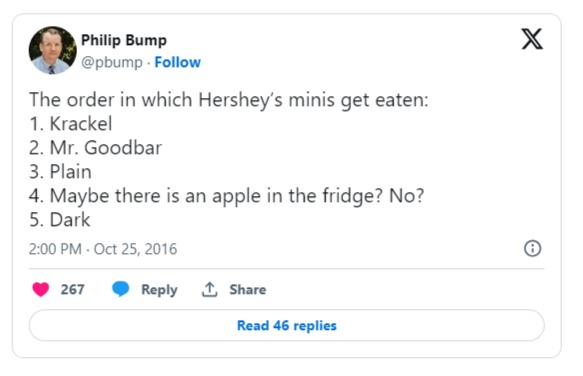
What these assessments haven’t fully accounted for, though, is the most fundamental division of all. Lurking at the heart of the Candy Controversies is the matter of milk chocolate versus dark chocolate, which is also to say Good Chocolate versus Bad Chocolate. Take this mini-ranking, from the Washington Post’s Philip Bump, which garnered approximately 5,000 replies, ranging from enthusiastic agreement to hot-fire objection, and started a small war of choco-partisanship:
So let’s settle it, once and for all—with the truth. Here, listed in no particular order, is definitive evidence that Milk Chocolate Is Superior to Dark Chocolate and If You Do Not Agree You Are Wrong Both Factually and Morally The End:
1. Milk Chocolate Tastes Good I mean. I mean. This isn’t even a debate, right? Let’s move on.
2. Dark Chocolate Tastes Bad Do you enjoy being reminded that the treat (“treat”) you are eating has been extruded from a crushed-up plant? Do you prefer desserts that go out of their way to inform you that they have been composed of beans? Then by all means, enjoy your Milky Way Midnight or whatever it is, but we really have nothing left to say to each other, because dark chocolate is bitter and aggressive, and, in general, I prefer my guilty-pleasure indulgences when they do not systematically attack me in the mouth. Also, dark chocolate is chalky. It doesn’t melt so much as it, for the most part, crumbles.
But I realize I am not an authority on this. So here is About.com—yes, the site so comprehensive in its knowledge of the world that only a preposition would do for its title—and its definitive Candy Glossary, which, it turns out, has already made the case for me (emphasis mine):
Dark chocolate is chocolate without milk solids added. Dark chocolate has a more pronounced chocolate taste than milk chocolate, because it does not contain milk solids to compete with the chocolate taste. However, the lack of milk additives also means that dark chocolate is more prone to a dry, chalky texture and a bitter aftertaste.
Right? Objective! And if you’re still not convinced, here is an actual academic paper that I did not purchase from Elsevier but whose abstract I definitely skimmed. It is titled “Sensory description of dark chocolates by consumers,” and its authors scientifically tested regular people’s assessments of the texture of dark chocolate. It concluded, scientifically:
With respect to mouthfeel, chocolate with a lower cocoa content was characterized as melting and creamy, whereas the product with the highest cocoa content was characterized as dry, mealy, and sticky.
Boom. Scienced.
3. Dark Chocolate Tastes Bad Specifically Because It Is Bitter But, okay, to be fair, some chalky things are tolerable, right? Smarties, for one (see above). But, as About.com suggested, it’s the bitterness that really does dark chocolate in, since even the sweetest versions of the stuff are, in some way, sour. Those Special Dark bars they put in the Hershey’s Minis bags to offset the Krackels (they’re the worst of the milk chocolate options, Philip, I’m sorry) and/or make the whole selection seem a little fancier? If “special” means “bitter in flavor but also bitter because you could be having a Mr. Goodbar instead,” then yes, these bars are extremely special.
4. Dark Chocolate Is Snobby I assume a) that there is a chocolate lobby, and b) that it has been working for many years to brand the more cacao-heavy versions of its products as luxury items. Just like DeBeers did with diamonds, Big Chocolate has seen to it that, while milk chocolate is accessible and ubiquitous, dark chocolate remains mysterious and exclusive. (See: the Ghirardelli Dark Chocolate Intense Dark Midnight Reverie® bar and its 86 Percent Cacao. Can’t argue with reveries!) And the branding, to be fair, has gone extremely well: Dark chocolate now has an image to maintain. Dark chocolate reads The Economist, and regularly quotes Bagehot to make all that reading worthwhile. Dark chocolate was totally into the restaurant before it was cool. Dark chocolate stopped liking the restaurant once it got cool. Dark chocolate hasn’t had a glass of Merlot since it saw Sideways. But dark chocolate is thirsty, so thirsty (and only partly because its mouth is full of mealy, chalky bean-chunks).
4.5. Milk Chocolate Is Basic, and That’s Totally Fine and Quite Possibly Pretty Great Do you enjoy a Pumpkin Spice Latte every now and then, and do you sometimes even refer to this beverage, simply for brevity’s sake, as a PSL, and do you generally not feel that either of these things should be treated as evidence of your moral turpitude? Would you sometimes prefer McDonald’s french fries dipped in barbecue sauce to some hand-cut pommes frites served with a thimble of aioli?
I agree. If you’d like, I have this amazingly delicious Hershey’s bar that I’d be happy to share with you.
5. Dark Chocolate Is a Marxist Nightmare Dark chocolate celebrates, in the most literal way possible, conspicuous consumption. Which, fine, is Veblen and not Marx, but they’re related, and anyway, something something bourgeois something something “responsibly sourced” and just see point 4 again, I don’t know. Dark chocolate is bitter and gross, I can’t believe we’re still having this discussion.
6. Dark Chocolate Is a Lie Oh! Right! Remember the Mast Brothers? The bearded hipsters who got famous selling fancy chocolate bars under the evil-genius, farm-to-table-y premise of “bean to bar”? The ones who, allegedly, just took regular old chocolate and put it in pretty paper and charged $10 a chunk and basically made a mockery out of everyone who has ever loved chocolate, which is very, very many people?
And remember when Hershey funded studies that suggested the health benefits of dark chocolate, and when Mars placed its chocolate products in health-food aisles at Walmart and Target, to give the impression that they were “nutrition bars,” because Big Chocolate really is everywhere?
7. But At Least Dark Chocolate Is Not White Chocolate White chocolate, to be clear, isn’t even chocolate. It is a product of chocolate’s aftermath: It is composed largely of cocoa butter—vegetable fat—that has basically been remaindered from the Vaseline lotion factory and then mixed with a sweetening agent and then squirted into foil and sold at a markup under the guise of confectionary indulgence, probably also under the direction of Big Chocolate.
So. Whatever your individual taste, whatever your random preference, whatever the complicated interplay of nature and nurture has led you to believe about what you happen to enjoy, candy-wise, this is the truth, and I will accept no other views. Except there is one tiny point, I’ll concede, that dark chocolate and its dark arts have going for them. White “chocolate” is proof that there is one thing worse than being bitter, mealy, untrustworthy snob-chocolate: not being chocolate at all.
* I also actively love Kraft Macaroni and Cheese, though, so basically take everything, when it comes to your correspondent’s culinary taste, with a grain of definitely-not-Himalayan salt.
I fall after Scott and before Chris and, well, obviously, little Markie. I also came after my own mother lost two babies who would have been my own brothers. And after she, Dorothy Elizabeth Rosina Myers-Cooksey soon-to-be Chesher, had been born in England during one World War and fled after living through a second, after her first husband, an RAF pilot, died in a crash, and after the country and people she knew no longer existed. She arrived in the U.S. in 1948, lost, alone, devastated.
When I watch and listen to the news on Ukraine, I hear my mother’s stories replayed, stories I never thought I’d hear again from Europe, and I think of all the pain yet to come.
Obviously, my mother met my father also a veteran of that second world war. They built a house on Jakeway and a second life together, they lost children, and they had me. And they met Lawrence and Phyllis. Thank the powers that be.
In my growing up, I only remember my mother having one real friend: Phyllis, even though Phyllis was 20 years younger than my mother. I don’t think many women of that time understood my damaged, foreign mother. I would only discover much, much later that Phyllis had weathered her own pain. Phyllis was certainly the only friend who would get down on my mother’s living room floor and exercise with her to TV’s Jack Lalanne; who would help her put on American birthday parties for me and bring her kids, who rapidly became my sister and brothers.
Phyllis taught me, and as importantly, my mother, so much by never teaching us anything. She simply was. The embodiment of calm, strength, clarity. Always there, always the same. Without her, I think the chaos of my own home would have overwhelmed us all.
To this day, I often dream of dinner at Schneider’s, around a dinner table that seemed to hold multitudes, all the kids, adults, Phyllis and her big dinners, complete with dessert. If there was contention and strife around that table, and I’m sure there was, I never felt it. What I felt was abundance, love, laughter, belonging.
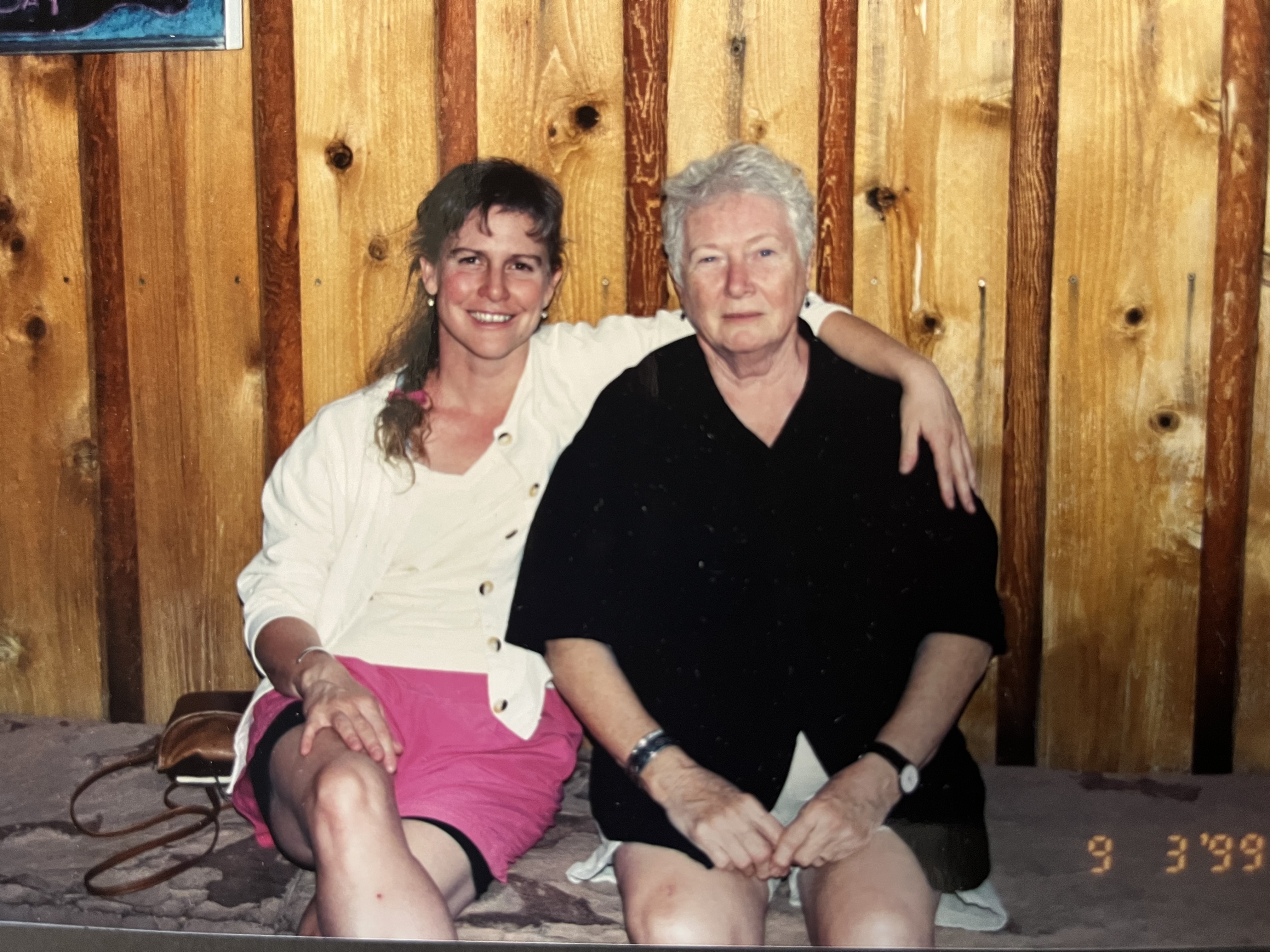
Phyllis presiding at the dinner table, 1961, and Pudge looking in the screen door
I hope, now, in times of strife and loss, I carry that with me and can offer it to those who need it, that clear-eyed, loving calm consistently modeled for me so long ago, and can bring it forth like Phyllis did when Chris and I were once again jumping on the forbidden, rusted, old, naked, box spring in the next door abandoned field and one of our feet, I can’t remember who’s, finally when through the springs. Bloody and smeared with rust, Chris and I guiltily drug ourselves home to be cleaned and bandaged by Phyllis with the simple admonishment, “now you kids…”. In my own home I would have been welcomed by yelling and a spanking first, bandages second, grounding third.
Chris tells me it was Phyllis too, who picked me up one day. I had made it a block or two down Jakeway, three years old or so, a bandana filled with my worldly possessions tied stick-end and carried over my shoulder like I must have seen in a book. “Where you going?” Phyllis asked. “I’m running away from home.” “Well, why don’t you come over to our house?” I guess I thought it over and accepted the opened door. I also recall being lovingly welcomed late one night for a sudden sleepover when I was perhaps five–how fun–Phyllis never letting on that my father was taking my mother away somewhere for care after the first, or perhaps just the most serious to date, of untold suicide attempts.
My home life wasn’t easy, nor did it get easier. My mother, lost in that unknowable country of mental illness, grief, and the horror of war, had too far a journey to come home. But every day, after school, while my mother worked, I went home to the Schneider’s, to the home Phyllis made. My mother and I had a calm, solid, friend in Phyllis standing at our sides. We did nothing to deserve such a gift. And I thank the powers that be Phyllis came to us, without strings and unbidden.
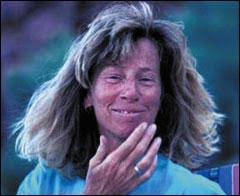
It’s hard to believe I’m now five years older than my friend Ellen Meloy when she died, though she was ten years older than me when alive. And even harder to believe she’d be 73 now. That’s one thing about dying young: so you are forever. She was thin, and tall, and gangly, with haywire red hair and goofy front teeth which she exploited for her own humor. She was a caricature of herself, and always the butt of her own jokes–always the straight-faced wit.
Before I knew her well, I had to study her closely after she said something I found hilarious, as I, forever in awe, didn’t want to guffaw if she was serious. I usually found her staring off at clouds, eyebrows raised, innocent of any implication. After knowing her longer, I dispensed with checking, and just burst out laughing, knowing whether she showed it or not, she was too.
When she died at 58, I remember thinking it was her way of getting the last laugh; that she was out there, just ahead of us on the trail, unseen, around the next bend, just out of sight, laughing at how we hadn’t gotten the joke.
It’s our great fortune that the good folks at KUER’s RadioWest recently uncovered a collection of essays Ellen wrote and read for NPR between 1994 and 1998. They partnered with Torrey House Press to publish them; the book is called Seasons: Desert Sketches by Ellen Meloyand will be published in April 2019. To buy it, click the Torrey House Press link above; to listen to Ellen read an essay, click here.
Here’s an article I wrote on Bluff, Utah and Ellen for the now defunct Wasatch Journal in 2009.
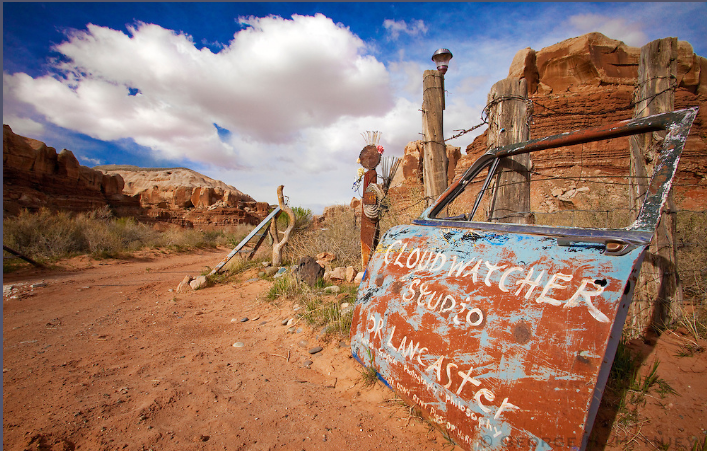
Copyright George H. H. Huey ~ Cloud Watcher Studio sign, Bluff, Utah
The Cosmic Nexus of Bluff, Utah
And the Woman Who Wrote It
Bluff, Utah. From a car hurling down Bluff’s main street, the two-lane SR191, a blink-of-an-eye tour reveals the San Juan River’s tamarisk-choked floodplain; Butler Wash’s wide, torrent-scoured arroyo; the pioneer-stopping Bluff Sandstone cliffs; and tumbleweed on course for Iowa. In town, dusty rutted sideroads struggle to maintain their Mormon-gird dignity while skirting mud wallows large enough to swallow a Hummer, and still provide access to an assembledge of dwellings perhaps best described as eclectic-historic chic. Bluff is funky and backwoods creative, or maybe desert-rat eccentric. In any words, Bluff is a sight to see.
Bluff is a pocket whirled into cliffs by dust devils, where unfurling winds dispense an indiscriminate accumulation. Empty wooden storefronts, the fading red of protracted sun exposure, and vintage trailer parks front the highway near a new timber-sided megahotel. Under ancient, breezy cottonwoods a beautiful, aged, handhewn-stone gas station stands abandoned and quite removed from the busiest place in town, the metalic quickmart that serves as grocery, gas station, and central communication network for Bluff and its multi-hundred square-mile, near roadless exburb.
Although Bluff is also home to a wonderful, if unconventional, restaurant or two; miscellaneous poets, sculptors, and painters; a bona fide coffee shop; some of the most beautiful sandstone-block Victorian homes in Utah, and the increasingly rare roadside stretch of junkyard sculpture, it’s the not the kind of place you’d expect to harbor a Pulitzer-prize finalist; a yearly arts festival drawing the likes of Terry Tempest Williams; or a fund encouraging desert literature, but there you have it.
About 250 people claim to live in Bluff these days. And although founded in 1880 by the Latter Day Saints’ famous Hole in the Rock Expedition (whose mission was to protect this remote quarter from invading gentiles with their cows and immoralities), it is now better known as the put-in for San Juan River trips. Latter Day Saints and river runners invaded the place in the last century—it was water that drew everyone here in the first place—making for an adventurous mix of caffeine-shunning rancher-Mormons; mocha-sipping, self-proclaimed misfits; holdover cowboys; Athabaskan-speaking Diné; missionary Episcopalians; erstwhile artistes and moon-eyed tourists all regarding each other suspiciously while doing the wash down to the Cottonwood Laundromat. Bluff’s slogan, “Whatever the Great Southwest is to you, you’ll find it ALL in BLUFF,” is alarmingly accurate. Bluff could be the accrued answers to a cosmic-scale free-association quiz.
You might be wondering why anyone would set roots here if they weren’t born to it, or for that matter, do anything but hit the accelerator on a drive-through, but, you see, that’s Bluff’s mesmeric charm. Amidst the seemingly endless miles of tawny, cliff-edged desert, Bluff serves as portal—not only to the desert’s ancient imagination, but to our own. A walk in any direction earns the San Juan River’s soothing waters, the Bluff Sandstone’s wind-carved hoodoos, and glimpses of prehistoric dwellings where rock art still radiates enigmatic messages. A daily seat under a lone pinon atop a sandstone ridge has been known to inspire more than one prize-winning book. In the world’s abundance of perfect, magazine-spread landscaping and arbitrated adventure travel, Bluff’s surrounding desert, with its unnumbered canyons, golden mesas, hidden springs, rescue-less dangers, and even its accidental distinctiveness is beginning to match roadside sculpture in rarity.
Ann Walka, a poet who splits her time between Flagstaff, Arizona and Bluff, says “There is a sense of endless space here, and the quiet spills from the canyons right into town. What people notice is so much more connected to the earth. Meeting on the road, people talk about last night’s moon or the neighbor’s hollyhocks. Bluff is a place where you have a sense of belonging and of privacy.”
Spectacular and idiosyncratic, Bluff’s sense of place is difficult to capture in words; luckily it was home to someone who wanted to spend a lifetime trying. If you want to experience Bluff’s enigmatic nature without the long drive, read Ellen Meloy. Perhaps best known as a Pulitzer Prize finalist for her book, The Anthropology of Turquoise; Meditations on Landscape, Art, and Spirit, Ellen moved to Bluff with her river-ranger husband in 1995. It was Bluff’s paradoxes that drew her: access to the nearby faraway, the desert’s striped-clean calm and blistering passion, its endless adventure and small embraces, the close community of “exibitionist hermits.” And Ellen fit right in. Tall, slender, her mind-of-its-own red-blond hair awhirl on the slightest breeze, her sun-baked skin glowed the color of redrock. Following those long, brown legs up a steep canyon from the San Juan River was a trot for anyone altitudinally-challenged. But even at her strong pace Ellen noticed the faintest pink blush of Indian paintbrush in bloom; spied the perfectly cryptic, thumbnail-sized baby toad popping away from moving feet. She knew the exact shade of the sky that day, turquoise not azure; summer’s intense light burned “the color of a sparkler’s core.” Ellen’s observations were always specific—detailed, accurate vignettes of thisparticular desert—her books’ language matched her brain’s precision and called a distinct vision of Bluff and her home desert into being.
Ellen wrote, “The San Juan River flows by my home and is so familiar, it is more bloodstream than place. Everything about it is tangible—a slick ribbon of jade silk between sienna canyon walls hung solid against a cerulean sky, pale sandy beaches, banks thick with lacy green tamarisk fronds, in which perch tiny gold finches.”
Ellen’s precise language had the unexpected effect of sending the reader not only from armchair to a full-body river dunking, but from specific to universal. Ellen evoked a deeper understanding, an echoing memory of an unfathomable connection we share with all that is not human, the pull that calls us still to places like Bluff. It may not seem many people would be fascinated with the intricacies of this remote landscape’s esoteric workings, but Ellen’s enthrallment and love burned from the page. She was able to speak openly about her sensual intoxication with this place, and by so doing evoke in others similar reactions. In her book, Eating Stone; Imagination and Loss of the Wild, Ellen writes, “Behind a gravel bar, a dense grove of tamarisk has turned the color of ripe peaches. An ellipse of pale rose sand lines the inside of a river bend of such beauty, you could set yourself on fire with the rapture of that curve. In it lies a kind of music in stone that might cure all emptiness.”
Imagine a beauty that could cure all emptiness. An impossible vision? Many find such a place on a slow meander through this landscape’s austere profusion. Melding into Bluff’s lonely quarter on an inflatable raft’s summer-warmed pontoon, your only responsibility to watch clouds morph indigo sky. Flat water’s languid current swirls the raft in gentle arcs as you trail fingers in water the color of liquid rock. As you drift by, cliffs seem to unroll, echoing wavelet lappings and reflecting water’s glitter in shaded overhangs. Or mold your body to a slickrock curve, hide from shoulder-slumping heat in cold-rock relief, nap, sleep, and dream of the lion curled here last night. Feel his full-bellied paddings as, across the river, he watches you now.
But, remember too, Bluff and it’s encompassing landscape is not Eden; it is instead quite real. There can be hardship here. Ellen’s book, The Last Cheater’s Waltz: Beauty and Violence in the Desert Southwest, details her realization that the stunning landscape of her own backyard is a deadly “geography of consequence.” Amid uranium tailings, missile ranges, and atomic test sites Ellen charts her “deep map of place,” contemplating a topography “where an act of creation can mean the complete absence of life.” This writer’s skill was complete, making us both desert esthete and activist.
Ellen’s sudden and unexpected death in 2004 caught her friends completely off guard. It was as if she slipped around some desert bend laughing, while our eyes were blinded by the sun. In the days following her death, many said, “o.k., Ellen, enough of the joke. You can come out now.” But Ellen, always a trickster coyote, didn’t respond. Ann Walka begins her lovely poem about Ellen with the line, “And for her next trick…” Somehow this death at home, centered on her personal map, suddenly and without fanfare, was very Ellen and very Bluff.
In Ellen’s remembrance and tribute to the place she and so many loved, friends and family created The Ellen Meloy Desert Writers Fund to encourage writing that combines an engaging individual voice, literary sensibility, imagination and intellectual rigor to create new perspectives and deeper meanings in desert literature. The Fund offers a yearly $2,000 award (now $5000) to an individual of similar passion and desire to go to their desert and write.
Although only in existence three years (since 2006), the Fund has provided much needed recognition for desert literacy, and sent two writers into the desert to scribe their own specifics of place. Rebecca Lawton of Sonoma County, California, the first Meloy Award winner, will continue our understanding of Utah’s many incarnations with her project Oil and Water. Lawton writes, “The Uintah Basin, home for millennia to people with wildly different views, still draws those of diverse descent and interests…Over time, everyone from ancient Puebloans to modern agriculturalists has lived on the Green River’s banks. Oil and Water will contrast attitudes toward this harsh but compelling place while bearing witness to demands each lifestyle places on the basin’s limited resources. The land will give testimony to those who inhabit it.”
The Award’s second winner hopes to capture an unwritten desert, replete with its own beauty and peril. Lily Mabura, currently of Columbia, Missouri, plans to travel to the Chalbi Desert and Lake Turkana in the North Eastern Province of Kenya, a region known locally as World’s End to write about the region’s nomadic ethnic groups and arid landscapes. Lily says, “It is difficult to travel to this region of Kenya due to extreme terrain and banditry or militia incursions from Ethiopia and Sudan. One must wait for armed convoys for escort…Like most Kenyans, I am petrified by the region, but there is the writer in me who really wants to see it and, gradually, my curiosity has eclipsed my fears, even though I suspect my real test is yet to come. I am hoping that my experience and the stories that emerge from it will enlighten others about this region, which deserves more attention in terms of humanitarian aid, education, security, environmental conservation and infrastructure.”
What these writers seek and what the Desert Writers Fund hopes to provide is what Ellen sought and found in Bluff’s abundance. Ellen wanted redrock and solitude, home and community. On her daily rounds she traversed river and canyon, garden and loving relationships, weaving everything into her own narrative of life and land, home and family. Ellen’s address and kin included slickrock and wandering bighorn, boiled lizards and the “brazen harlotry” of the desert in startling bloom. Ellen knew narrow slickrock canyons to be the halls of her own home, mule deer as neighbors, and the muddy San Juan as provider. She felt—and desperately wanted to communicate—the human use and abuse of nature was as dangerous as sawing off the limb on which we sit. If we soil the ground with atomic fallout, she said, decimate the bighorn’s last stronghold, dam the last rivers—we damn ourselves.
Perhaps Bluff’s significance, its message, is that regardless of our back-of-the-hand-on-forehead human tribulations and dreadfully significant problems, unexpected, funky, irresponsible, glorious possibility exists by the bucketload, and beauty—healing, transformative beauty—still lives in the world. Go, create some junkyard sculpture; go, lie in the desert and dream yourself awake.
In Ellen’s Words
One morning in a rough-hewn, single-room screenhouse, in a cottonwood grove but a few wingbeats beyond the San Juan River, I poured scalding water through a paper coffee filter into a mug that, unbeknownst to me, contained a lizard still dormant from the cool night. I boiled the lizard alive. As I removed the filter and leaned over the cup to take a sip, its body floated to the surface, ghostly and inflated in mahogany water, its belly the pale blue of heartbreak.
I sat on the front step of the screenhouse with sunrise burning crimson on the sandstone cliffs above the river and a boiled reptile in my cup. I knew then that matters of the mind had plunged to grave depths.
With these words Ellen began her second book, The Last Cheater’s Waltz: Beauty and Violence in the Desert Southwest, a book about the “geography of consequence.” At the end of this opening prologue, Ellen describes most clearly what she was questing for in life and writing. After fishing the lizard from her coffee and unfolding a Colorado Plateau map, she carries lizard, map and notebook to a sandy bench, and writes:
Beside a thick stand of rabbitbrush I spread out the big map and anchored its corners with stones…” “First I marked my present location with a small, shapely O. Next I reduced the Colorado Plateau to a manageable two hundred square miles or so around the home O. Then I outlined this perimeter on the map with a ring of fine red sand trickled from my fingers. A circle has no corners. So, to make my Map of the Known Universe portable, I transcribed all that fell inside the circle into sections and roughed them out on pages in the notebook, like an atlas.
As the sun rose higher, the cliffs shed their crimson light and turned flat and brassy. Tenderly, blue belly down so it would not sunburn, I placed the lizard on the map. The small corpse rested on our land—literally on the very dirt where my husband and I were soon to build our house—on the O, at the center of the circle.
It was time to get to know the neighborhood.
This, without doubt, is my favorite passage from Ellen’s writing; it is unexpected, funny and at the same time poignant and a clear manifesto of Ellen’s life and purpose. Ellen wrote four books about getting to know Bluff and her Four Courners neighborhood.
While the multi-award winning Anthropology of Turquoise is a tour de force, another of my favorites, Eating Stone is, to me, the most Ellen-like. The book reminds me of sitting atop a sandstone outcropping low over the San Juan River with Ellen, hearing what she’s been up to and laughing in the sun’s warmth. About camping in the desert with friends while tracking bighorn, Ellen writes,
Sunrise in the redrock desert has the calm of water. Strange that it be thus in a parched expanse of rock and sand. Yet this is how it comes: a spill of liquid silence, sunlight the color of embers, every surface bathed in it. The heart aches to live to see the start of a day, every day, luminous in the unmoored distance.
How can there be such quiet among a most garrulous species grouped together in space and task—no voices yet? I believe that the quiet prevails because all of us are desert people. We are known gazers into the horizon at early hours. That pause between social discourse and the solitude of the senses feels acute today…Perhaps the quiet is accidental prayer, an attentive stillness that conflates perception with desire. Maybe it is sleepiness at the early hour or the fact that some among our group are quite bashful. The low sun torches the buttes and mesas around us. Each saltbush stands distinctly silver-green on the cayenne red pediment, casting its own violet shadow. The light is what we watch, what steals our voices.
Somewhat amazingly and out of the blue, or grey as the case may be today, I stumbled upon the blog I attempted to keep before blogging was a viable technology and while I attempted to ride a horse from one end of the island nation of England to the opposite end of Scotland. While neither worked very well I do recall that most folks complained they never got to read the blog. So, if you care to read it’s abbreviated life, you’ll find a link below.
I see that many of the posts I sent from my various outposts never made it to the blog; England in 2009/10 was still the land of paying to connect in crowded, London-only foggy-windowed literal chat rooms where one paid for a computer by the 1/2 hour, and where whenever I asked where there might be wireless hookups or cell phone connections, Brits and Scots alike stared snob-nosed at my obvious alien-ness! And this although Americans kept stopping to ask directions of this one approachable-looking, and obviously exceedingly rare, nice British lady (i.e., me)! My apologies to all those Yanks who, in my best British accent, I sent on Wild Goose Chases!
Researcher Finds Way to Fight Cheatgrass, a Western Scourge
The New York Times
By Christopher Solomon
Oct. 5, 2015
Cheatgrass could vie for the title of the most successful invasive species in North America. The weed lives in every state, and is the dominant plant on more than 154,000 square miles of the West, by one estimate. When it turns green in the spring, “you can actually see it from space,” said Bethany Bradley, an assistant professor at the University of Massachusetts, Amherst, who studies biogeography, the spatial distribution of species.
The sins of cheatgrass are many. Its tenacious seeds lodge in the eyes and gums of livestock (not to mention the ears of pets and the socks of hikers). Even a moderate infestation in a wheat field can reduce yields by up to half.
Its profusion is a big reason today’s Western fires burn more land, more frequently and with more ferocity than in the past, scientists say. Unlike well-spaced native bunchgrasses, cheatgrass — its scientific name is Bromus tectorum, or downy brome — crowds tightly together and then dies early each summer to form dense mats of tinder.
After fires, cheatgrass thrives even as native flora struggle to return.
After more than a half-century of largely failed efforts to thwart the Sherman’s march of cheatgrass, a researcher may have a powerful new weapon against it.
Ann Kennedy, a soil scientist with the Agricultural Research Service of the United States Department of Agriculture, has discovered naturally occurring soil bacteria that inhibit the growth of the weed’s deep root system, its competitive advantage, even as those bacteria leave native plants untouched.
Ann Kennedy, a soil scientist with the Agricultural Research Service has discovered naturally occurring soil bacteria that are being tested as a way to kill cheatgrass while leaving native plants untouched. Credit Ruth Fremson/The New York Times
Dr. Kennedy’s hunt for a cheatgrass killer has been nearly 30 years in the making. In 1986, she was investigating yellowed wheat in the Palouse country of eastern Washington State when she found some bacteria that appeared to inhibit the number of shoots that the wheat sent skyward, but not the wheat plant’s overall yield; the plant just made bigger kernels. Dr. Kennedy wondered if a bacterium could be used to frustrate weeds instead.
With help from undergraduates at Washington State University, where she is an adjunct professor, Dr. Kennedy tested 25,000 bacteria she took from nearby farm fields. Her goal was to find ones that satisfied a wish list of ideal attributes such as hindering cheatgrass while not affecting wheat. She likened the search to picky online dating.
The researcher finally settled on two strains of Pseudomonas fluorescens, a huge species of bacteria that is present throughout the natural world. Most of its strains perform beneficial functions in the environment.
In long-term field trials around the inland Pacific Northwest, including Hanford Reach National Monument in Washington State, Dr. Kennedy’s bacteria reduced the amount of cheatgrass in test plots by about half within three years of a single application.
“We get it down to near zero weeds within about five or six years,” Dr. Kennedy said, as other plants recover and grow more competitive. The bacteria also dispatch two other invasive plants, medusahead and jointed goatgrass. The latest findings will be published within the next year, she said.
July 15, 2015
These bacteria work differently than quick-killing herbicides, she said. Once a concentrated solution is sprayed on the land, successive generations of the organisms establish themselves in the soil, then colonize the roots of the cheatgrass.
Cheatgrass’s chief advantage is its roots: They can grow more than 30 inches deep. They grow later into the fall and earlier in the spring than those of native plants, monopolizing the soil’s water and nutrients. The bacteria produce a compound that inhibits normal root growth, however, removing this edge.
“It’s not a matter of if it works or not,” said Mike Gregg, a biologist with the United States Fish and Wildlife Service who is familiar with Dr. Kennedy’s work. “The question is, can we take what she has done at a small scale and do it at 10,000, 20,000, 50,000 acres?”
The bacteria are living, and if not applied under the right conditions, they “can croak,” said Jerry Benson, the owner and manager of BFI Native Seeds in Moses Lake, Wash., a habitat restoration firm that is working on protocols for applying the bacteria.
One of Dr. Kennedy’s strains has already been approved for use by the Environmental Protection Agency; a commercial product is expected to be released in the fall of 2016. Dr. Kennedy has even higher hopes for a second strain, now in the approval process.
Sept. 16, 2015
Interest is high because the need is urgent. Earlier this year, Interior Secretary Sally Jewell ordered a new strategy to address the wildfires — fueled by cheatgrass — that are torching huge parts of the West’s sagebrush landscapes. The resulting losses of habitat were a big reason the greater sage grouse was considered for the endangered species list. (The federal government declined to list the bird last month, citing new recovery plans by state and federal agencies.)
Dr. Kennedy acknowledges that her discovery isn’t a silver bullet. Though whipping up the bacteria “is like brewing beer,” she said, spraying 100 million acres of the West would be prohibitively expensive. What’s more, the cheatgrass could eventually return.
Instead, she and others envision tanker aircraft, like those that dump water on wildfires, treating miles of fire breaks with the bacteria, to clear them of the weed and slow the spread of fires.
Professor Bradley, of the University of Massachusetts, Amherst, whose models show that cheatgrass could advance into northern Wyoming and eastern Montana because of climate change, said Dr. Kennedy’s bacteria also might help hold the line.
Asked if she worries that she might be replacing one problem with another by spreading these bacteria, Dr. Kennedy replied: “It’s in our soils. It’s just not in high enough numbers to do the job.” The bacteria naturally die after four years, she added.
Dr. Kennedy said that over the years she and colleagues selected for use only the strains that had entirely benign traits, screening them for their harmlessness on more than 250 grass plants in addition to insects, birds and rats.
She believes she has found solutions to other weed woes beneath our feet, too. “Really, there is a beauty to soil,” she said. “It’s just absolutely a wonder world of activity. You just have to go in search of it.”
A version of this article appears in print on October 5, 2015, on Page D2 of the New York edition with the headline: A Way to Cut a Weedy Bully Down to Size.
You may know that I [the Minneapolis writer, Kelly Barnhill] spent spring 2013 engaged in a grueling editorial process with my upcoming novel The Witch’s Boy. This was through no fault of my beloved editrix Elise Howard, who is brilliant and amazing and right about everything.
This has everything to do with me. And with the work of novel production, and novel refinement, and novel discovery, and novel re-discovery. And, believe me, it is work.
Revising a novel is building a granite castle. And then taking it apart and building it again. By hand. By yourself. And then, when you’re done, you run a marathon. Barefoot. While carrying a very heavy and very ill-tempered goose. It’s kind of exactly like that
Revising a novel is a return to a garden that you planted a while ago – one that you know is loaded with vegetables, but you cannot see them because the weeds now tower, jungle-thick, over your head
Revising a novel is that colicky baby that will not go to sleep no matter what you do
Revising a novel is the thick, muddy traverse through a swamp, only to realize that you have to climb a cliff on the other side. And you forgot your rope
Revising a novel requires the skin of a rhinoceros and the strength of a bull and the delicacy of a jeweler
Revising a novel feels like performing open-heart surgery. Without anesthesia. On yourself
Revising a novel requires you to heft a thousand-pound boulder, sling it onto your back, carry it up a mountain, and balance it on the head of a pin
Which is to say that revising a novel is effing hard.
And that’s the case generally, and in the case of The Witch’s Boy, it is even more so. This book is incredibly close to my heart, and was often emotionally exhausting to write. I have always loved my characters, but, in this novel, I – for real – love these characters. Partially because I didn’t come up with them on my own. This story began, very long ago, as a story that my son and I told one another during a particularly grueling hike through Shenandoah National Park when he was only six. There is a lot of Leo in Ned. There is a lot of me in Aine. And Sister Witch. And the Bandit King. Hence my struggles.
Also, there’s something about working with a new publisher – it’s exciting and inspiring and energizing, but also nerve-wracking. Because we want to get it right. And we want to make people happy with us. And we want to not suck. This is the way of things.
So I worked my bum off, took three months to write two crucial chapters that were going to re-imagine and re-focus the larger arc of the novel, allowing the choices and action to flow from a single nexus point where my main characters converge, bear witness, keep silent, and irrevocably change their trajectories.
Three. Long. Months.
And….maybe it worked? We’ll see.
Anyway, apparently, in the last revision, I managed to grow the novel by ten thousand words. And that was after some major textual excising. Which explains a thing or two.
And now I am, once more, into the brink. I have tools. I have a map. I have my dear editor sounding her trumpet and spurring me onward. I have a lantern. I have a sword. I have a pure heart and a just cause and a mind on fire. I have characters to rescue. I have giants made of stone. I have a stalwart wolf and a ferocious girl and a boy who does not know what he is capable of. I have my heart and my brain and my love, and I hope it will be enough.
Anyway, I will be posting some out-takes here and there.
Like this:
He was alive. For now.
“Ha!” a man said, shaking his fist at the water. “It won’t be taking this one, by god. Only one victim for that blasted river.” He gave the river a hard look. He did not help the father, nor did he touch the boy. Everyone in the village knew that those marked for drowning were cursed by nature. The river was a greedy thing. And foul-tempered. It would have that boy eventually. This was common knowledge.
And this:
This was not magic. This was a simple practicality. Witching, after all, is tricky work. And complicated. She had learned, after all these years, to see the world from the inside – its foundation and its beams, its braces, insulation and gaps. She knew the weak places. She knew how lean against the fabric of the world and nudge it this way or that. She knew how to make suggestions. Anyone could do it, if they ever learned. But people called it magic, and conflated it with her real magic, and Sister Witch didn’t correct them.
Her real magic was dangerous – capable of great good and great evil in equal measure. It was work keeping it good. It required a firm hand and an iron will. Best to use it sparingly, if at all.
And this:
The ladies from the village came in droves. They descended onto the grieving house like an army of magpies, all feather and gossip and claw. Sister Witch thought she’d never be rid of them, and suffered the indignities of grief in relative silence.
“It’s a pity,” the magpie ladies simpered. “Such a terrible pity.”
Go away, Sister Witch seethed.
“And on such a beautiful day,” as they munched on the pastries they had brought for the family.
She thanked her visitors for their meat pies and fruit pies and custard pies and pies she could not identify or name. She thanked them for their pots of stew and their legs of lamb and their heavy rounds of hard cheese. Their gifts were thoughtful, tender, and full of wiles.
They were gifts that asked questions.
Sister Witch had no intention of answering a thing. Her son, Tam, was dead. Her magic could not save him. And that was that.
Here’s the thing: it doesn’t matter how deft your hands may be, or how sharp your scalpel or how cunning your eye. Cutting away bits and pieces of our novels – fingers, toes, tumors, tongues, unsightly moles or pounds of pulsing flesh – well, it hurts.
A lot.
And because I hate being alone and wallowing in psychic pain, I turn it over to you. Any sections that you’ve cut lately? Any extraneous scenes that simply detracted from the central pulse of your novel – that single, beating heart? Paste it here and share! Our amputated novel bits can assemble and congregate. They can bind together into hideous and beloved homunculi. They can resuscitate, respirate, ambulate, and live.
Here is Faust and his homunculus. It worked for him, right?
And it will be beautiful.
Kelly Barnhill won the Newbery Medal for her children’s book, The Girl Who Drank the Moon, and is getting much acclaim for her latest book for adults, Dreadful Young Ladies and Other Stories, a collection of dark, whimsical fantasies. Listen as she talks with NPR’s Lulu Garcia-Navarro about it here.
Kelly is an author, teacher and mom. She wrote THE GIRL WHO DRANK THE MOON, THE WITCH’S BOY, IRON HEARTED VIOLET, THE MOSTLY TRUE STORY OF JACK and many, many short stories. She won the World Fantasy Award for her novella, THE UNLICENSED MAGICIAN, a Parents Choice Gold Award for IRON HEARTED VIOLET, the Charlotte Huck Honor for THE GIRL WHO DRANK THE MOON, and has been a finalist for the Minnesota Book Award, the Andre Norton award and the PEN/USA literary prize. She was also a McKnight Artist’s Fellowship recipient in Children’s Literature.
Kelly lives in Minneapolis, Minnesota with her three brilliant children, architect husband, and emotionally unstable dog. She is a fast runner, a good hiker, and a terrible gardener. You can visit and chat at her blog: http://www.kellybarnhill.com
I began this blog in May 2012 with the post, A Book Worth Swallowing Whole–The Joy of Cannibalism, after reading Miracle in the Andes: 72 Days on the Mountain and My Long Trek Home, by Nando Parrado and Vince Rause. I wrote in that post: if you were alive in 1972 you will remember the famous Andes crash of the plane carrying the Uruguayan rugby team. Sixteen of the original 55 or so passengers and crew survived two-and-a-half months in frigid, impossible conditions by consuming those who didn’t. The story was made into a book and movie (Alive!); the rescue was a world-wide astonishment.
Nando Parrado, you might recall, was one of the two (then young) men who hiked out after surviving 72 days without, ah, shall we say, routine food or water. In doing so, they saved themselves and the other 14 from certain death.
Nando Parado 2009
At the time of my original post, I didn’t realize a documentary (2009) had been made about the incident, and having just watched it, I wanted to share it. You’ll need a strong stomach for only a couple scenes (it looks like chicken).
I think of Parado’s book often (it’s way better than the documentary–but the film is interesting) and wanted to share the one line that stayed with me this entire time. It’s what Nando’s father said to him when he returned (remember both his mother and one sister died in the crash along with many of his closest friends whom he had also eaten), and it is the title of this post. I think of that line whenever things float up from my past to haunt me, and I suggest you do the same when your ghosts visit you.
I’m regularly inspired by Richard Gilbert’s Blog, and by Todd Henry, The Accidental Creative, both of which I’ve pushed on many of you, and if you haven’t visited either site yet, I’m pissed.
In my postThinking and Feeling, Richard Gilbert’s comment about how most of us “seldom think about one thing for hours on end” made me think about Todd Henry’s podcast on Deep Work and how that ability may be the challenge of the future. I know I find it difficult, especially when I’d rather be outside.
“Deep, sustained attention is a scarcer resource than it once was… bigger feats, bolder ideas unfold over the long haul—in the space where success feels uncertain, even unlikely. It’s work that will be complex and staggeringly difficult, and made up of many individually disappointing days. By focusing only on what satisfies in the moment, or by being too easily put off by drudgery and discouragement, the real work never has a chance to begin.”






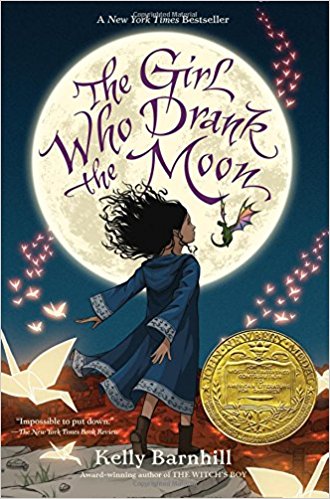 Kelly is an author, teacher and mom. She wrote THE GIRL WHO DRANK THE MOON, THE WITCH’S BOY, IRON HEARTED VIOLET, THE MOSTLY TRUE STORY OF JACK and many, many short stories. She won the World Fantasy Award for her novella, THE UNLICENSED MAGICIAN, a Parents Choice Gold Award for IRON HEARTED VIOLET, the Charlotte Huck Honor for THE GIRL WHO DRANK THE MOON, and has been a finalist for the Minnesota Book Award, the Andre Norton award and the PEN/USA literary prize. She was also a McKnight Artist’s Fellowship recipient in Children’s Literature.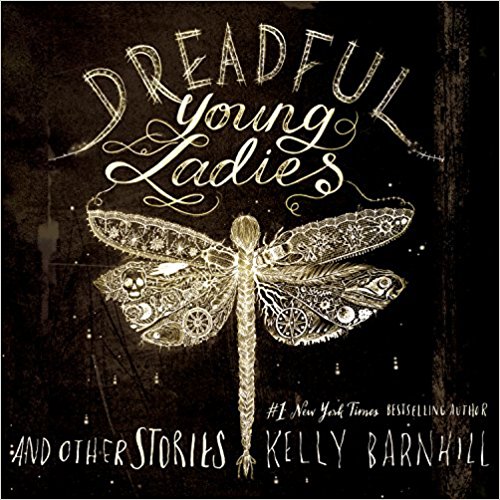
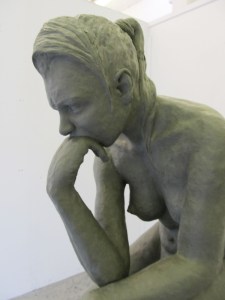
 The Occasional Chair