Ed Chamberlin was born in Rochester, Michigan in 1958, only 216 miles away, and two years after, my own illustrious Michigan birth. I can’t remember the first time I met Ed, when we both worked at Grand Canyon National Park in the late 1980s, but I think this was something we bonded over: we were both Michiganders born in the wrong place and time. We both, though we never met in Michigan, wanted to live in the West of those midcentury Westerns: we wanted to ride the open desert with Roy Rodgers and Dale Evans; four-wheel the rugged expanse with Pat Brady and his jeep Nellie Belle, fly with Sky King over endless vistas, and we both loved Tonto best, Kemosabe.
We loved the west of myth, and when old enough, we headed to that enchanted land of wide-open spaces, far from Eastern conventions, in search of our true selves and a place of meaning. And, I think, we both found it. And we found each other, what are the chances?, and never lost our love for our chosen home or each other.
As you may or may not know, Ed suffered from diabetes, and I do mean suffered. He was diagnosed at a young age and spent incalculable hours managing its effects throughout his life. He hated it. The time it took, the unending beeping from his glucose monitor waking him in the night and pestering him by day. He liked to ignore the smaller fluctuations of these unending demands. He felt best when his blood sugar was low, most of the time so low as to be on the verge of crashing. At this level, he felt happy and energized; but, if his sugar levels dropped a few more points, he became giddy and silly, with the goofy fun of a little kid. And we loved his enthusiastic embrace of life as much as he did.
But …when his sugars hit the tipping point, crazy things happened. Everyone who spent time with him has funny, scary stories of these moments perched on the edge of mind-numbing insulin shock.
Should I take him to the hospital? (I’ve done it). Should I cut to the head of a long line of people at a packed Disneyland concession to demand an orange juice, right now, and leave in such a rush I don’t pay for it? (yes). Should I demand he pull over immediately, and when he won’t (because, he says, he’s fine), should I lie and say I’m starving and need a McDonalds hamburger, also right now? (Yes). Or should I laugh with him till I can’t breathe like the crazy people we both were? (Absolutely). If there was one thing Ed loved, it was to laugh. He found life (except diabetes and cancer) extremely humorous.
He loved silly things like glow-in-the-dark dinosaurs and Jesuses, Virgin Marys and aliens; he loved goofy postcards, and improbable roadside art because, it made him laugh.
And Ed loved the outdoors, and spent much time kayaking, hiking and exploring what the wild world offered. He loved learning from other cultures and traveled the world connecting with people far and wide. He made it to all seven continents. He talked often about how he loved the Uyghur people of China and wanted to return; he was planning trips abroad right till the end.
And he loved beauty and history and worked his entire adult life to preserve both, to preserve our memories of the beauty humans have made: pottery, rugs, paintings, artifacts—a record of our own interactions with the natural world—our attempts to render the Southwest’s beauty and ethereal presence into a resonant form. He loved New Mexico and its many peoples, their place-based cultures and evocative art.
And he loved his husband Lyle. His partner in crime, a soul with whom he could also resonate. Their passions merged in each other. He loved supporting Lyle’s art, helping with studio tours, art fairs, photography, and radio shows. He was happiest assisting Lyle in any endeavor. More than once, Ed turned to me, tears in his eyes, and sobbed, “I love him so much!”
And Ed loved science. Except when it came to cancer. He did not want to know anything except whether the drugs were working. And they weren’t. After two years of pain, chemo, radiation, and experimental drugs, Ed died on October 10, 2024, one month short of his 66th birthday, from an extremely rare form of prostate cancer for which there was and is no cure. He did not want to go. He fought with everything he had.
We the friends, we the blessed, who by some miracle, were placed for a brief time on this wild earth in Ed’s presence, and were allowed to bask in the glow of true friendship, will remember this amazing man as the one who stood beside us no matter what, who made us laugh and brought us joy. We can only hope to do the same for others through Ed’s example.
If there’s two things I love it’s chocolate (milk) and smart, funny, kickass writing. In this great article from The Atlantic’s Megan Garber, we get both. Enjoy.
By Megan Garber OCTOBER 27, 2016
I generally enjoy milk chocolate, for basic reasons of flavor and texture. For roughly the same reasons, I generally do not enjoy dark chocolate. *
Those are just my boring preferences, but preferences, really, won’t do: This is an age in which even the simplest element of taste will become a matter of partisanship and social-Darwinian hierarchy; in which all things must be argued and then ranked; in which even the word “basic” has come to suggest moral judgment. So IPAs are not just extra-hoppy beers, but also declarations of masculinity and “palatal machismo.” The colors you see in the dress are not the result of light playing upon the human eye, but rather of deep epistemological divides among the world’s many eye-owners. Cake versus pie, boxers versus briefs, pea guac versus actual guac, are hot dogs sandwiches … It is the best of times, it is the RAGING DUMPSTER FIRE of times.
But back to chocolate. These micro-debates lend themselves especially well to candy, it turns out, which is probably why, this spoooooky time of year, candy rankings join heated discussions of the latest predictably offensive Halloween costumes as seasonal Stuff to Talk About. (It’s controversial candy season, motherfuckers!) And so, cumulatively, 21 Kinds of Halloween Candy, Ranked and A Ranking Of 40 Halloween Candies From Nastiest To Raddest and the 52 Best and Worst Halloween Candies—Ranked and A Definitive List of the Best and Worst Halloween Candy, Ranked and their many other counterparts have combined to bestow judgment.
And the judgment, collectively, if I may sum it up, is that candy corn is disgusting and also weird-looking, and Mr. Goodbar is the superior selection in the Hershey’s Minis bag, and Mounds are proof that God loves us, and Raisinets are proof of the opposite, and Reese’s Peanut Butter Cups are proof that even in these turbulent times it could turn out that committed monogamy makes a certain sense. Also: Nerds are warty nonsense; Whoppers are okay but why are their coatings so shiny; Butterfingers are delicious but also possibly Illuminati-left clues about impending apocalypse; the best M&M color is red and the blue ones are trying too hard and the oranges are trying not hard enough and let’s not even start on the green; Rolos are fine; Milk Duds are unacceptable; Smarties are good in an “actually…” kind of way; Twix are what they are, but—wait for it—also demand the plural verb; Snickers are, obviously, at the very tippy-top of the Halloween hierarchy, but only if they’re Fun-Sized, and if someone puts a regular-sized version into your bag, that person is most likely either over-compensating for something or trying to murder you with the tiny razor blade that has been lodged between the peanuts and the nougat, and it probably goes without saying but while we’re on the subject of Snickers, any candy that bills itself as Bite-Sized can GTFO, which means Go to Functional Overload, and if you have a different interpretation then you can go functional-overload yourself.
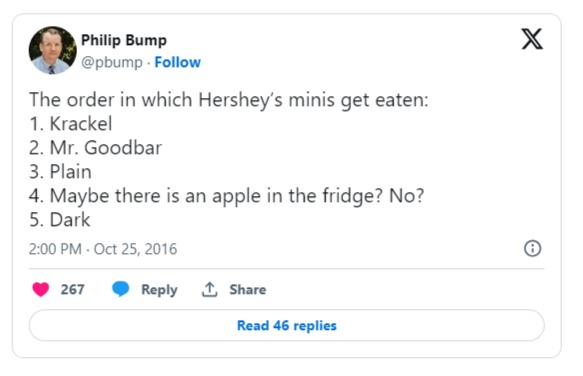
What these assessments haven’t fully accounted for, though, is the most fundamental division of all. Lurking at the heart of the Candy Controversies is the matter of milk chocolate versus dark chocolate, which is also to say Good Chocolate versus Bad Chocolate. Take this mini-ranking, from the Washington Post’s Philip Bump, which garnered approximately 5,000 replies, ranging from enthusiastic agreement to hot-fire objection, and started a small war of choco-partisanship:
So let’s settle it, once and for all—with the truth. Here, listed in no particular order, is definitive evidence that Milk Chocolate Is Superior to Dark Chocolate and If You Do Not Agree You Are Wrong Both Factually and Morally The End:
1. Milk Chocolate Tastes Good I mean. I mean. This isn’t even a debate, right? Let’s move on.
2. Dark Chocolate Tastes Bad Do you enjoy being reminded that the treat (“treat”) you are eating has been extruded from a crushed-up plant? Do you prefer desserts that go out of their way to inform you that they have been composed of beans? Then by all means, enjoy your Milky Way Midnight or whatever it is, but we really have nothing left to say to each other, because dark chocolate is bitter and aggressive, and, in general, I prefer my guilty-pleasure indulgences when they do not systematically attack me in the mouth. Also, dark chocolate is chalky. It doesn’t melt so much as it, for the most part, crumbles.
But I realize I am not an authority on this. So here is About.com—yes, the site so comprehensive in its knowledge of the world that only a preposition would do for its title—and its definitive Candy Glossary, which, it turns out, has already made the case for me (emphasis mine):
Dark chocolate is chocolate without milk solids added. Dark chocolate has a more pronounced chocolate taste than milk chocolate, because it does not contain milk solids to compete with the chocolate taste. However, the lack of milk additives also means that dark chocolate is more prone to a dry, chalky texture and a bitter aftertaste.
Right? Objective! And if you’re still not convinced, here is an actual academic paper that I did not purchase from Elsevier but whose abstract I definitely skimmed. It is titled “Sensory description of dark chocolates by consumers,” and its authors scientifically tested regular people’s assessments of the texture of dark chocolate. It concluded, scientifically:
With respect to mouthfeel, chocolate with a lower cocoa content was characterized as melting and creamy, whereas the product with the highest cocoa content was characterized as dry, mealy, and sticky.
Boom. Scienced.
3. Dark Chocolate Tastes Bad Specifically Because It Is Bitter But, okay, to be fair, some chalky things are tolerable, right? Smarties, for one (see above). But, as About.com suggested, it’s the bitterness that really does dark chocolate in, since even the sweetest versions of the stuff are, in some way, sour. Those Special Dark bars they put in the Hershey’s Minis bags to offset the Krackels (they’re the worst of the milk chocolate options, Philip, I’m sorry) and/or make the whole selection seem a little fancier? If “special” means “bitter in flavor but also bitter because you could be having a Mr. Goodbar instead,” then yes, these bars are extremely special.
4. Dark Chocolate Is Snobby I assume a) that there is a chocolate lobby, and b) that it has been working for many years to brand the more cacao-heavy versions of its products as luxury items. Just like DeBeers did with diamonds, Big Chocolate has seen to it that, while milk chocolate is accessible and ubiquitous, dark chocolate remains mysterious and exclusive. (See: the Ghirardelli Dark Chocolate Intense Dark Midnight Reverie® bar and its 86 Percent Cacao. Can’t argue with reveries!) And the branding, to be fair, has gone extremely well: Dark chocolate now has an image to maintain. Dark chocolate reads The Economist, and regularly quotes Bagehot to make all that reading worthwhile. Dark chocolate was totally into the restaurant before it was cool. Dark chocolate stopped liking the restaurant once it got cool. Dark chocolate hasn’t had a glass of Merlot since it saw Sideways. But dark chocolate is thirsty, so thirsty (and only partly because its mouth is full of mealy, chalky bean-chunks).
4.5. Milk Chocolate Is Basic, and That’s Totally Fine and Quite Possibly Pretty Great Do you enjoy a Pumpkin Spice Latte every now and then, and do you sometimes even refer to this beverage, simply for brevity’s sake, as a PSL, and do you generally not feel that either of these things should be treated as evidence of your moral turpitude? Would you sometimes prefer McDonald’s french fries dipped in barbecue sauce to some hand-cut pommes frites served with a thimble of aioli?
I agree. If you’d like, I have this amazingly delicious Hershey’s bar that I’d be happy to share with you.
5. Dark Chocolate Is a Marxist Nightmare Dark chocolate celebrates, in the most literal way possible, conspicuous consumption. Which, fine, is Veblen and not Marx, but they’re related, and anyway, something something bourgeois something something “responsibly sourced” and just see point 4 again, I don’t know. Dark chocolate is bitter and gross, I can’t believe we’re still having this discussion.
6. Dark Chocolate Is a Lie Oh! Right! Remember the Mast Brothers? The bearded hipsters who got famous selling fancy chocolate bars under the evil-genius, farm-to-table-y premise of “bean to bar”? The ones who, allegedly, just took regular old chocolate and put it in pretty paper and charged $10 a chunk and basically made a mockery out of everyone who has ever loved chocolate, which is very, very many people?
And remember when Hershey funded studies that suggested the health benefits of dark chocolate, and when Mars placed its chocolate products in health-food aisles at Walmart and Target, to give the impression that they were “nutrition bars,” because Big Chocolate really is everywhere?
7. But At Least Dark Chocolate Is Not White Chocolate White chocolate, to be clear, isn’t even chocolate. It is a product of chocolate’s aftermath: It is composed largely of cocoa butter—vegetable fat—that has basically been remaindered from the Vaseline lotion factory and then mixed with a sweetening agent and then squirted into foil and sold at a markup under the guise of confectionary indulgence, probably also under the direction of Big Chocolate.
So. Whatever your individual taste, whatever your random preference, whatever the complicated interplay of nature and nurture has led you to believe about what you happen to enjoy, candy-wise, this is the truth, and I will accept no other views. Except there is one tiny point, I’ll concede, that dark chocolate and its dark arts have going for them. White “chocolate” is proof that there is one thing worse than being bitter, mealy, untrustworthy snob-chocolate: not being chocolate at all.
* I also actively love Kraft Macaroni and Cheese, though, so basically take everything, when it comes to your correspondent’s culinary taste, with a grain of definitely-not-Himalayan salt.
I fall after Scott and before Chris and, well, obviously, little Markie. I also came after my own mother lost two babies who would have been my own brothers. And after she, Dorothy Elizabeth Rosina Myers-Cooksey soon-to-be Chesher, had been born in England during one World War and fled after living through a second, after her first husband, an RAF pilot, died in a crash, and after the country and people she knew no longer existed. She arrived in the U.S. in 1948, lost, alone, devastated.
When I watch and listen to the news on Ukraine, I hear my mother’s stories replayed, stories I never thought I’d hear again from Europe, and I think of all the pain yet to come.
Obviously, my mother met my father also a veteran of that second world war. They built a house on Jakeway and a second life together, they lost children, and they had me. And they met Lawrence and Phyllis. Thank the powers that be.
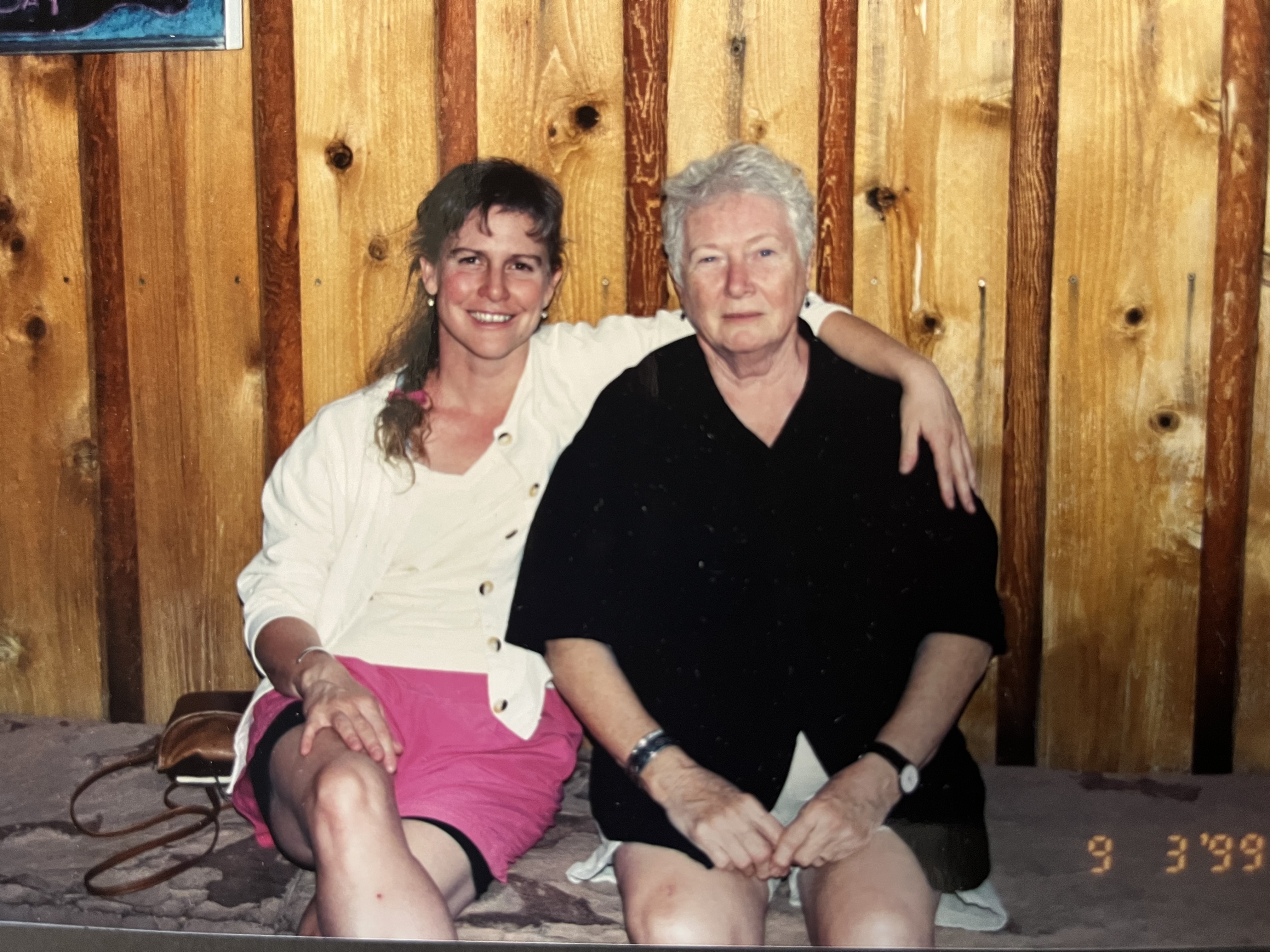
In my growing up, I only remember my mother having one real friend: Phyllis, even though Phyllis was 20 years younger than my mother. I don’t think many women of that time understood my damaged, foreign mother. I would only discover much, much later that Phyllis had weathered her own pain. Phyllis was certainly the only friend who would get down on my mother’s living room floor and exercise with her to TV’s Jack Lalanne; who would help her put on American birthday parties for me and bring her kids, who rapidly became my sister and brothers.
Phyllis taught me, and as importantly, my mother, so much by never teaching us anything. She simply was. The embodiment of calm, strength, clarity. Always there, always the same. Without her, I think the chaos of my own home would have overwhelmed us all.
To this day, I often dream of dinner at Schneider’s, around a dinner table that seemed to hold multitudes, all the kids, adults, Phyllis and her big dinners, complete with dessert. If there was contention and strife around that table, and I’m sure there was, I never felt it. What I felt was abundance, love, laughter, belonging.
Phyllis presiding at the dinner table, 1961, and Pudge looking in the screen door
I hope, now, in times of strife and loss, I carry that with me and can offer it to those who need it, that clear-eyed, loving calm consistently modeled for me so long ago, and can bring it forth like Phyllis did when Chris and I were once again jumping on the forbidden, rusted, old, naked, box spring in the next door abandoned field and one of our feet, I can’t remember who’s, finally when through the springs. Bloody and smeared with rust, Chris and I guiltily drug ourselves home to be cleaned and bandaged by Phyllis with the simple admonishment, “now you kids…”. In my own home I would have been welcomed by yelling and a spanking first, bandages second, grounding third.
Chris tells me it was Phyllis too, who picked me up one day. I had made it a block or two down Jakeway, three years old or so, a bandana filled with my worldly possessions tied stick-end and carried over my shoulder like I must have seen in a book. “Where you going?” Phyllis asked. “I’m running away from home.” “Well, why don’t you come over to our house?” I guess I thought it over and accepted the opened door. I also recall being lovingly welcomed late one night for a sudden sleepover when I was perhaps five–how fun–Phyllis never letting on that my father was taking my mother away somewhere for care after the first, or perhaps just the most serious to date, of untold suicide attempts.
My home life wasn’t easy, nor did it get easier. My mother, lost in that unknowable country of mental illness, grief, and the horror of war, had too far a journey to come home. But every day, after school, while my mother worked, I went home to the Schneider’s, to the home Phyllis made. My mother and I had a calm, solid, friend in Phyllis standing at our sides. We did nothing to deserve such a gift. And I thank the powers that be Phyllis came to us, without strings and unbidden.



 The Occasional Chair