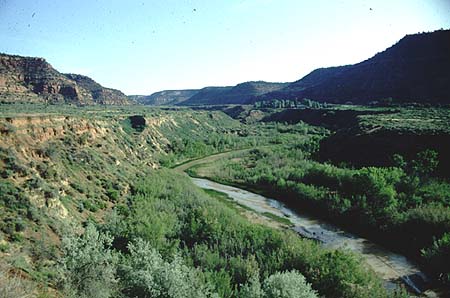
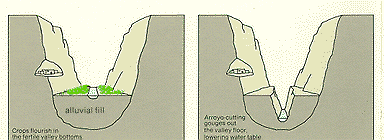
Although it has eroded and aggraded many times over the last few million years, the Kanab Creek arroyo (Utah) began its latest manifestation on a July afternoon in 1883.
From the Hard-To-Believe File: a little over one month ago I wrote about preparing my 1960s travel trailer for evacuation in Utah’s extreme heat. In the last week, I received many National Weather Service Flash Flood Emergency Alerts via cell phone. Jarring disaster tones screeching from my pocket are new; summer flash floods are not. On July 29, 1883, Kanab residents watched a flood rip, in one afternoon, the meandering, crop-level Kanab Creek a new home: the 90-foot-deep, cliff-walled arroyo we know today. This caused, ahem, a few problems for those who ate only what they could grow. Not only was most of their year’s crop (and its field) on course for Grand Canyon, but also there would henceforth be a bit of a problem irrigating whatever was left, given the crops were now perched 90-feet above the stream. Thus ensued hundreds of years of erecting dams, digging ditches, and cursing, well, whatever was and is cursed.
Tsegi Canyon (Navajo National Monument)
This cycle of arroyo cutting and filling has been repeated every few millennia depending on rain and whether sediments are washed away or build steadily over time. Rain is most likely tied, as in the 1883 storm, to El Nino events. There was another Southwestern erosional cycle ca. 1200-1300, which may have contributed in the same way to Puebloan abandonment. And if it doesn’t stop raining soon this year, I may be moving to the DRY Tortugas.
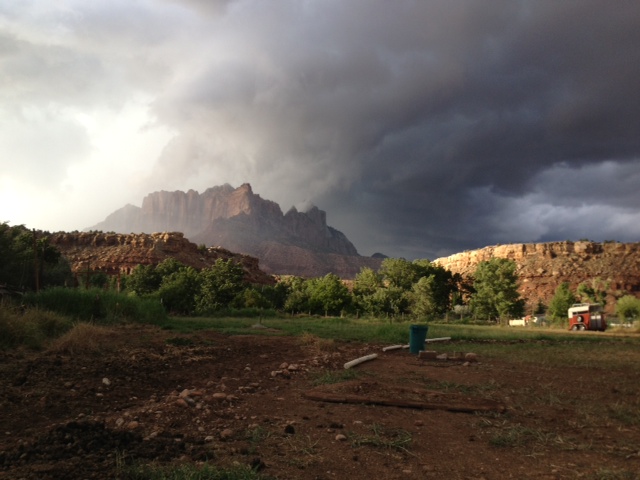
Last week a tropical storm’s swirling clouds uncoiled overhead like a galaxy’s spiral, the only evidence of their passing successive waves of heavy rain. This was a September rain, one that lingered and turned days to jackets and umbrellas, not the usual August afternoon monsoon of suddenly refreshed hikers. A winter storm when great storms hove off the heavy, grey-waved Pacific, desert skies mirror roiling oceans, and mountain ponderosa warm desert adobes aswirl in sea-cast winds.
But today the breeze blows warm, and rain falls from monsoons bubbling off overheated southern deserts. Mr. Harris, taken by the cancer long-ago, used to say that’s where the big storms came from, the big flash floods. Not the west, from out across the Great Basin where the Pine Valley Mountains’ drain a storm’s last waters, but from the south, “Down off The Sand,” he’d say, “Down off The Sand up to Pipe Spring, following the Mail Trail over from Kanab.” He said southern storms were big because they got caught by the canyon, circled around and came in the wrong way. Angry. The biggest floods he’d seen.
Calling its battalions
When I moved to Zion Canyon in the 1980s, afternoon monsoons and summer flash floods were clockwork reliable. Every day about 3 or 4 p.m. the day’s wadded-tissue clouds, inflated by desert-heated thermals and dead-headed by the Troposphere, burst with their accumulated moisture. Monsoons and floods were common in Mr. Harris’ day too, and in the late 1800s, but not so much in the 1990s – 2000s, although this summer has certainly been wet! Whyizat?
Zion sits precisely at the monsoon’s western extent, and when that boundary shifts, summer rains never come. Our monsoon-edge location also means more of our annual precipitation arrives in winter than summer. Canyonlands and Arches, with similar elevations and rainfall, are more centered in monsoon boundary and thus receive their annual precipitation about equally between summer and winter—a small difference with great effect.
Winter’s slow rains soak more deeply into the soil, benefiting deeply rooted plants such as shrubs and trees. Summer rains flash across the soil, aiding shallow-rooted species, forbs, for instance. Thus winter rains create different plant (and thus animal) communities than summer-shifted precipitation. Further, different plant species use water at different times. That way, one species or another will survive no matter when it rains. Ingenious.
But some plants use water only during certain seasons; if rains arrive at the wrong time, these plants ignore it. That’s one reason environments can differ: the seemingly inconsequential difference of when rain falls.
Now for the kicker: scientists anticipate that global climate change will not only shift (is shifting, has shifted) the monsoon boundary, but also has/is/will affect seasonal precipitation. The U.S. Geological Survey states a switch to a drier climate, particularly reduced winter rainfall, will reduce groundwater recharge, lessen perennial stream water, increase strong winds and dust storms, weaken biological soil crusts, reduce plant cover and change species composition, remobilize sand from stable dunes, and increase forest and range fires.
What will this mean for us humans besides having to dust more often? In Zion, reduced winter rainfall will shift vegetation boundaries; different species will invade and replace the Colorado Plateau species we’ve come to know and love. Economic plants such as ponderosa pine (lumber) will survive only in the smaller acreages available at higher elevations; piñon and juniper will die off or move to higher elevations, leaving lower elevations to heat-adapted species, creosote for example. Grasslands will fill not with native grasses, but with such invasive exotics as unpalatable cheatgrass (there goes the wildlife neighborhood). The lifestyle and economy we’ve based on the present regime will change—drastically.
With luck, there will be time for us to change with it—for ranchers to learn new skills, for farmers to switch to crops adapted to hotter, dryer summers. Less water might mean mass human movement away, just as it did for Anasazi and pioneer alike. The species Zion hoped to protect will be gone. It’s something managers have never confronted before: their park up and moving away. If we hope to protect a certain species, we may have to set aside lands now where we think that species might end up later. Bizarre to be sure, but also necessary if we hope to plan for the future. This is not idle speculation. Scientists who study butterflies are already predicting that with climate change, the monarch’s Mexican refuge will be too cold and wet for the species to survive the winter. Can you imagine a summer without monarchs? I don’t want to.
All these dire predictions remind me of pre–Hurricane Katrina warnings of what New Orleans would experience after being hit by a massive hurricane whipped to a frenzy by global warming: broken levees, flooded wards, stranded populations, decimated wetlands. The preceding forecast is the Southwestern version of Hurricane Katrina—a list of things that will change so slowly we won’t notice until they hit us unprepared and head-on.
A recent climate study predicts that at our current rate, atmospheric carbon dioxide concentrations will double from preindustrial levels by 2070, triple by 2120, and quadruple by 2160. The study predicts “profound transformations; some potentially beneficial, but many disruptive. Climate zones will shift hundreds of miles north.”
It’s true that the Zion we see today is just one data point on an evolving continuum. Zion has always changed; that’s the one constant. But now, we’re the agent and we’re moving too fast. At one time a large forest covered Zion and extended to Grand Canyon’s lowest level; as ancient climate changed, sotoo did the forest. The difference was that the transition happened slowly, giving plants and animals time to adapt. But when climate change happens quickly, well, ask the dinosaurs how well that worked.
It’s easy to feel powerless against such overwhelming forces. But the real take-home message is act now. The longer we wait, the worse the consequences.
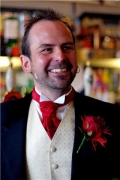
This handsome chap is Colin Dolby. He put out in his fishing boat five years ago from Leigh-on-Sea England, and was never seen again. Because his wife Jane couldn’t prove he was dead, she could neither claim a widow’s pension nor access his bank account. According to the BBC World Service, Jane and their two children, aged seven and three, had to rely on charity, friends, and the Fishermen’s Mission to pay their rent and buy food.
Eight months after Colin’s boat disappeared, Jane booked herself and the kids a July day out on a steamship that leaves from Leigh-on-Sea, at the sea’s junction with the Thames, and runs up and down the great river. And this first time Jane returned to the water, Colin washed ashore.
Jane had once loved to sing, but after Colin died, she found singing too emotional; she would dissolve in tears each time she sang. So she stopped. For four years. Until she got an idea: she’d round up a couple fishermen’s wives, make a cheap CD, sell it in the local pubs, and donate the resulting hundred pounds or so to the Mission that helped her so much. WELL.
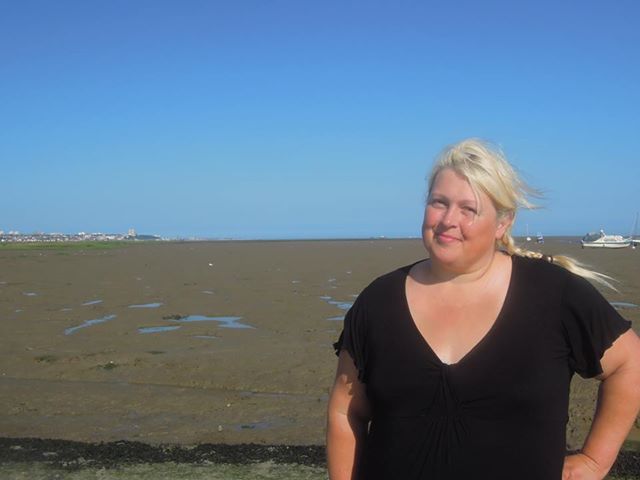
Jane Dolby
She posted a note to a few Facebook friends, it went viral, and within 48 hours she had her choir. All the women in the choir are either related to, are themselves, or have lost fishers. It turns out there’s too large a pool of potential choir members as fishing is known as one of the most dangerous jobs in the world during peacetime: one in twenty fishers will die or be seriously injured doing their jobs. Hear the Fishwives Choir.
I have been mulling this story over the week or so since I heard it, puzzling what made it so meaningful. I certainly love the outcome, the uplifting tale of one heartbroken woman picking herself up after tragedy and her dedication to paying back what was so generously given. And I love the song–the lilting tune, Jane’s beautiful voice, the two songs’ interwoven net, the choir’s full voice, and the coming together of like-minded women in a community of spirit. But what I really think moved me was the aspect of this story that fits into a recurring theme of this blog: the power of art. Jane was totally overwhelmed and surprised when what she offered came back to her with such force. She chose to express all that had happened–the tidal wave of grief and loss, financial ruin, fear for herself and her children, terror for the future, four years of pain—in art, singing, a form she thought she would never be able to use again. And the result, almost too beautiful to bear, now bears her into the future.
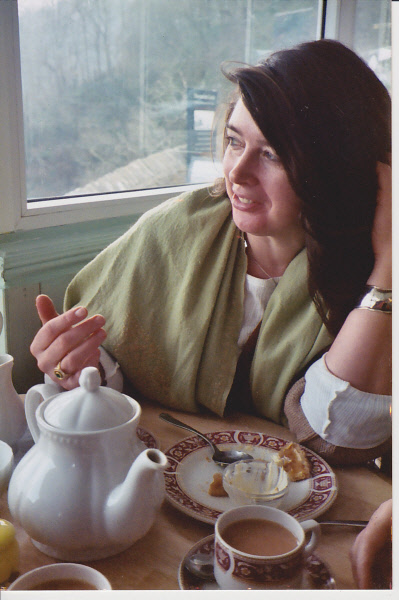
This image of Eleanor O’Hanlon in Dartmouth Castle Tearoom is my personal favorite; the photo speaks volumes to me. It was made in 2003 after a long walk along the English coast and through the castle on a mizzly day. This coffee lover will admit there is nothing quite like a pot of tea, scones, clotted cream, and jam shared over a fantastic ocean view on a rainy day.
But there is also the incredible Eleanor whom I met at Devon’s Schumacher College in a course called Animal Magic taught by the likes of Jane Goodall, Rupert Sheldrake, Francoise Wemelsfelder, and Colin Tudge. Although the course opened my eyes wider, late nights in the library with Eleanor were even more informative.
Schumacher’s Library
It was there three of us would meet long after everyone else was abed—Eleanor (an Irish nature writer and conservationist living in London), Ursula (a belly dancing Viennese psychiatrist), and me (an American park ranger)—along with whomever else could match our late-night habit —occasionally a Danish veterinarian, a Polish zookeeper, a Belgian dairy farmer. We retrieved the wine bottle from behind the woodpile; lit a fire in the immense, dressed-stone fireplace (parts of the building dated to the 1300s); wove human-sized nests of multitudinous cushions; and settled in for a wine-fueled chat. My favorite part was when Eleanor told Irish folktales.
And my favorite tales were of Ireland’s boy warrior, Cú Chulainn and his training with its greatest warrior Scáthach, because Scáthach was a woman, and Eleanor was, and is, a Storyteller. How I wish I had recorded those nights in front of the fire! Eleanor’s magical voice! If truth be told—and this is between you and me—I think Eleanor is Scáthach!
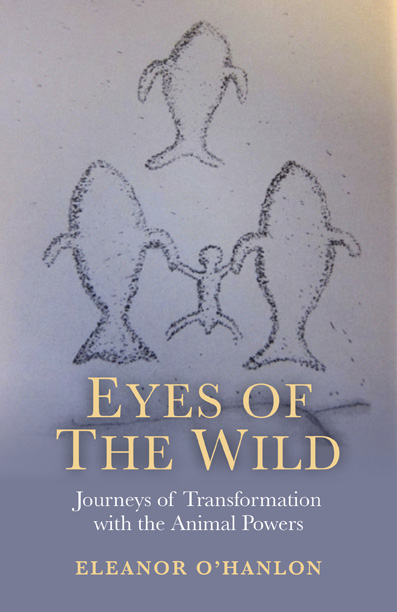
And now we get the next best thing—a book from Eleanor, and a fabulous one it is. In Eyes of the Wild Eleanor not only describes her encounters with whales and bears, wild horses and wolves, and the scientists and wardens who watch and watch over their dwindling numbers, but she goes further. I told you the story of Eleanor of Schumacher because during those moments I was not a 40-something, grieving, orphaned (I had lost, the year before, both parents to the Great Beyond and a boyfriend to what? indifference?), anyway, I was not a somewhat lost soul, I was a warrior learning to fight with a barbed spear on a fierce North Sea island—such were, and are, the power of Eleanor’s words. Eleanor takes us beyond an animal in an environment and beyond even ourselves to the one thing that binds us all. And she takes us there by telling stories of things that are, and things that are not. I cannot do her book justice. I have loaned two copies to friends, and the books have yet to come home. Hopefully, they are on their own warriors’ journeys.
An Excerpt:
When the mother surfaces next she comes close enough for me to reach out and touch. I run my hands along the skin of her side, which feels indescribably smooth, as though the texture has been endlessly refined by the washing of the sea. Her flesh is firm and cool beneath my hands. Through the physical contact with her body a sense of the expansive dimensions of her being opens inside me like soundings from some vast interior sea. As the depth of the meeting grows, it becomes an opening through which something entirely new keeps pouring—a wordless sense of connection with a greater life.
Turning onto one side, the whale gazes up at me through the water; looking down into her dark eye, ringed with folds of skin, I meet the lucid and tranquil gaze of an ancestor, one of the ancient ones of the earth. I feel her taking me out, far out, of thought and linear time, beyond the limited concerns of my ordinary mind, into a profound sense of meeting with another being, whose consciousness is not separate from my own…
Eden, I think, is not simply a mythical place, or a metaphor for original innocence, or an outworn and divisive religious symbol. Eden is a state of being, and we are free to return every time we know ourselves again in deep communion with the rest of life.
When I was a kid, my British mother insisted we take down the Christmas tree before New Year’s Eve saying, “its bad luck to have an old tree in the new year.” This year, in contravention of Medieval European superstition, I have left my lime-green tinsel-branched tree standing. Although I consider myself a neo-pagan, atheistic heathen, I do celebrate Christmas. I do so to honor the multi-millennia human instinct to worship sun, trees, and planetary motion. But this year, I too, bow to trees.
Christmas trees, historically, came from this same impulse. Although Christmas-tree history was long ago mislaid amid myriad dusty files, we know the ancients venerated trees. From Roman evergreen boughs hung during the winter solstice Saturnalia festival to the pine, spruce and fir branches draped above windows and doors worldwide to deter witches, ghosts, evil spirits, illness and the like, people have long sought reassurance in mid-winter’s conifer green.
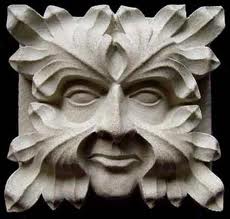
But long before December ensnared our imaginations with pine scent, trees enchanted people. European ceremonies performed today from dim memory—May Pole dances, Jack O’ The Green ceremonies, English tree dressing, Green Man Festivals—speak to a long history of arboreal reverence and respect—respect, that is, for trees that escaped the ax. Because, for as long as we have esteemed trees, we have felled them.
Humans clear-cut prehistoric forests worldwide as soon as they figured out how—stone axes, bronze, iron, steel—our technologies ever more efficient. Woodlands retain only a tiny roothold on once vast territories, and the trend has always been downhill. Except. Except for three small periodsin human history when forests, joy of joys, vigorously rebounded.
We know forests convalesced AD 200 to 600, 1300-1400, and 1500-1750 because ice cores record plummeting CO2 levels during these periods. Of the CO2-absorbers—oceans, trees, and intact soils—only regenerating woodlands account for this change. The next question is, of course, what revived these forests? The answer isn’t very pretty, but gives us hope.
Just before each restoration, massive pandemics—smallpox, bubonic plague,typhus, cholera—decimated human populations, in some cases by ninety percent. Dogs nosed along empty town lanes. Farms stood deserted. Within fifty years, agricultural lands reverted to the wild. Trees long cropped by pigs, horses, cows, and farmers sprung from the soil. Everywhere the forest returned.
Now you know just how much I love nature, but I find great comfort in William Ruddiman’s research. It means we have a chance; something I have doubted for a long time. After a pandemic, people: burned less carbon, cut fewer trees, and, in their own absence, accomplished immense forest rejuvenation. Let’s see: burn less carbon, cut no trees, and recreate forests. We can do that! And I’m not talking about miserly, Ebenezer Scrooge forests; I’m talking majestic, obese, enormous, heroic, gigantic, native forests!
So, to echo Michael Pollin’s omnivores advice (“Eat food. Not too much. Mostly plants.”); I offer: “Plant trees. Anywhere you can. As soon as possible.” It’s time we worshipped trees again.
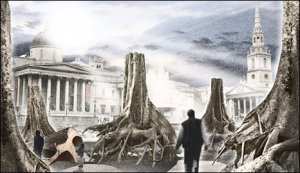
Artist Angela Palmer’s Trafalgar Square project, Ghost Forest: ten massive tree stumps from what remains of Ghana’s tropical rainforest. The exhibit sought to raise public awareness of connections between deforestation and climate change.
This image haunts me.
I couldn’t help but think how immense forests once stood not only in the Amazon, but where London now stands. Although I understand we must assist other countries with avenues to prevent deforestation, we too have obligations: to reforest our own denuded lands. The Ghost Forest is everywhere beneath our feet.
I was thinking again this morning how odd a beast is art. An idea springs into one’s mind, rolls about in there like a sandstone block in a flash flood until sufficiently rounded, then has to be arm wrestled onto the page, honed and sanded and polished until the thing somewhat resembles a lumpy, almost distinguishable, marble. And for what?
I think, for the artist, there is a certain relief in that the nagging thing has been ectomized, and a definite let down in that it appears not quite in the way envisioned or hoped. Art is a concrete approximation of an ephemera, and not always a close one at that. And then there is the this-matters-to-me-I-hope-it-matters-to-you thing. I’ve blogged about this before. One sends something into the Universe, and the damn thing doesn’t bother to write home. Has this thing that struggled to be born made the slightest difference? Does it matter to anyone? Does it need to? Well, of course, it doesn’t, but one hopes…
Which brings me to the two latest Postcards from the Universe, one in the form of a winning contest entry (and a nice little check), and the second in the form of a real, live person who wants to use what I’ve written to talk to other people. I love it when that happens. Art lives.
Here is my winning entry in the Z-Arts! Writing Contest, Adult Non-fiction Category, and a nice note from a Zion National Park guide: “I’ve read through the winning entries and am so impressed with the quality of the writing. Thank you to Z-Arts for organizing this annually. I found one of the writings really poignant and would like to contact the author, Greer Chesher, to see if I can get permission to use his writing in one of my interpretive programs. Thank you so much!”
The contest theme was Canyon Voices. You can read all the winners at the Z-Arts! website.
Canyon Voices
Long ago, I lived in what were then the wilds of New Mexico. Only an hour from Santa Fe, the Pajarito (Little Bird) Plateau’s thick ponderosa forests concealed from the unsuspecting world not only the Los Alamos National Lab, but native tribes, their ancestral tufa-built homes, and living traditions. My best friend, a young native runner from nearby Jemez Pueblo, was the second-youngest son of a man old even then. One afternoon, sharing a bowl of posole and deer meat scalded with more red chili than my Michigan-bred mouth had ever encountered, my friend’s father told me how, if a hunter does things right, the deer will offer itself to the hunter. Puzzled, I took a much needed break from my tongue-blistering to look his way. He, looking at the floor, continued, “when the animal gives its life for the hunter, he should be there, breathe in the deer’s last breath, give thanks.” I looked from him to my friend, unsure if this message was meant for me or his son. “If you don’t honor this gift, it will be taken. The deer won’t come.” He rose then, headed out, but before leaving reached into a pottery bowl next to the door, pinched a bit of its powdery contents between weathered fingers, and nonchalantly tossed it into the corner fireplace. The pollen offering streaked golden through filtered light. I sat motionless, silent, eyes wide.
This memory returns unbidden as I sit beside southern Utah’s Virgin River watching pollen, the color of sunlight, puffed brightly by the wind. It is as if the trees, knowing we’ve forgotten how to honor the land, do our work for us, without asking. A perpetual offering. Overhead, Canada geese honk their way downriver, sounding like ungreased wheels or a swinging door’s rusted hinges. Yellow warblers call from riverside willow winding down like a spun dime. Unexploded cottonwood pods swell and cliffrose flowers unfurl beyond our hearing. Fish swim, owls glide, rodents burrow, microbes reproduce—so much of this canyon’s daily life goes on beyond our keenest perception. Yet where would we be without it? Our physical and other-than-physical lives depend on so much we cannot see, smell, or taste, on the canyon’s unheard voices.
But perhaps, in ways still beyond our understanding, we can feel them. Richard Nelson, in his book, The Island, wrote, “As time went by, I also realized that the particular place I’d chosen was less important than the fact that I’d chosen a place and focused my life around it. Although the island has taken on great significance for me, it’s not more inherently beautiful or meaningful than any other place on earth. What makes a place special is the way it buries itself inside the heart, not whether it’s flat or rugged, rich or austere, wet or arid, gentile or harsh, warm or cold, wild or tame. Every place, like every person, is elevated by the love and respect shown toward it, and by the way in which is bounty is received.”
Gibbs Smith said in his book, Blessed by Light, “the Colorado Plateau chooses its people.” Although not from here, these writers remind us of our place, of what we forget to hear; they toss the pollen.
U.S. Poet Laureate Robert Hass wrote, “Thoreau read Wordsworth, Muir read Thoreau, Teddy Roosevelt read Muir, and you got national parks. It took a century for this to happen, for artistic values to percolate down to where honoring the relations of people’s imagination to the land, or beauty, or to wild things, was issued in legislation.”
Four influential people speaking, writing, changed the world. But it took a century. We don’t have a century to protect what’s left. But we do have thousands, millions of people who can be influential, if we speak of what the land tells us. Barry Lopez wrote, our job “…is to undermine the complacency of how most people relate to the landscape.”
The canyon speaks for itself, but quietly and of paintbrush in bloom, the drip of springs, the shockwave of rockfall. It’s ours to speak in a language the canyon can’t, to beings who may not hear. The canyon cannot protect itself. Only we can do that. We are the canyon voices. Are you one of the chosen? Do deer offer themselves? If you are lucky and this place proffers itself to you, the question becomes, what will you do with this gift? Speak.
Many thanks to Niles Ritter, Luci Brantley, Charlotte Vaillancourt, Gigi Krause, and Chip Chapman for making the awards ceremony so lovely.
Fire on the mountain, catastrophic to man, of passing annoyance to the mountain. I Ching
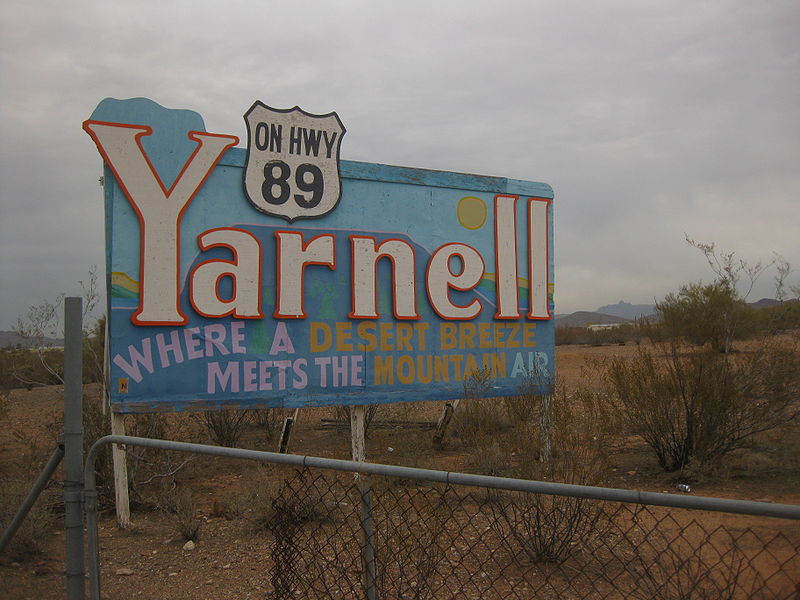
The day after Yarnell, I restocked my tiny travel trailer with evacuation’s irreplaceables: 23 filled journals, my British mother’s 19th Century sepia photographs of people and places long gone, a painting of my heart’s companion, Bo the Adventure Dog, now-deceased. In an enthusiasm of labor, I also fixed the flat on my horse trailer, bought a new spare, finished the dangling wiring, and loaded the hay rack. I stowed a five-gallon water can, full, in the trailer bay, along with saddles, halters, bridles, and whatever other costly-to-replace gear I could manage. I put the horses’ favorite treats in the mangers and set the incentive stick on the wheel well. I should have done all this the day before Yarnell because this is fire country and because I knew it was coming. Just last week I’d said, “It’s gonna burn this year, and burn big.” And then, forgetting, I went home, propped my feet in my small home’s sweet air-conditioning, and basked in the green, irrigated oasis that is Rockville, Utah. But it could, just as easily, have been us.
Yarnell, Rockville, a thousand other small towns throughout the West, remote and compact, aggregated in the only places possible: Rockville where water and irrigable land drew farmers in 1860, and Yarnell where water and gold drew miners in 1865. People stayed long beyond the initial impulse, living a modern life on antiquated townsites, disengaged from original purpose and desert reality. Yarnell, bigger than Rockville, has more than three streets and three times the population, but like most Western towns both grade from watered trees and gardens to brittle, boulder strewn hills with few exit routes where, even in good years, meager precipitation nurses a scruffy fire-prone forest of sage, blackbrush, juniper, scrub oak.
In years past clockwork monsoons relieved summer’s drought, and lightning sparked cleansing fires. Regular burns consumed light accumulations of downed wood and autumn debris, moving slowly through desert grasses, pine needles, and spiny oak leaves. But settlement brought fear: for 150 years fires were doused, wood accrued, and fires turned wild. Increasing summer temperatures, precipitation’s slow dwindling, shifting monsoons, and stockpiled combustibles fuel wildfire’s new ferocity. The last two decades’ combined controlled-burn acreages are small consolation in a West ready to burn. There isn’t much to be done except pack the trailer.
This, if and when it comes, will be my fourth evacuation: twice for fire and once for flood, though I didn’t leave that time, choosing to stay in my darkened town where my horses stood, heads hanging, in improvised day-glow-orange emergency blankets, fetlock deep in mud. It was December and after more rain than I’ve seen in all my desert years, belly-heavy, gunmetal clouds rested like slipped lids far below Zion Canyon’s redrock lip. Upstream, the sodden, earthen dam on Short Creek threatened, and I didn’t know where to take the horses. I do now.
Today, men dressed in crinkly nomex, fire-crew green and yellow, mill about the town fire station, waiting. No one speaks of Yarnell. In this town where everyone has worked, knows someone who has worked, or now works for fire, the 19 are not mentioned. No one says, “Did you hear…?” No one says, “What do you think…?” We all know. It’s as if, like freshly provisioned fire packs sitting by front doors and riding in pickup beds all over town, the news is almost too heavy to carry.
This summer I cannot irrigate, sprinkle, or haul enough water to keep my garden alive. Tomatillos wilt, honeysuckle stunts, pasture grass browns. Having livestock ups the ante: dead grass means hungry horses, costly hay, a more serious evacuation. My tenuous connection with Rockville’s past beats a bit more true, but I can buy my way out of a drought, shop my way past failed crops; I can leave.
Today the acrid smell of smoke fills the canyon, the sun’s odd eclipsed light. The world throbs orange haze. A fire south near Las Vegas, someone says, or north near Minersville puffs signals on strong, hot winds. I look to the travel trailer, askew in the yard, my “I-can-only-pull-one-trailer-at-a-time” plans thwarted by the latest flat. I planned to move it to a friend’s house deep in the Big City’s irrigated green, leaving me free to deal with the horses’ panic and mine. I hate evacuation’s grab-everything adrenalin confusion, the irritating nag of something forgotten. As evening settles, storm clouds grading violet to blue-black thicken over the canyon. Do they bring rain’s release? Lightning’s fire? Slickrock’s flood? Evacuation?
One of reading’s delights is that one will discover a Great Book. Great Books are defined by the individual, not the mob, and each person’s Great Book List will vary by personal idiosyncrasy. I’m listing books as I find them, and will probably, at some point, add my All Time Favorites, books some of you have taken on, including Waterlog by Roger Deakin, Sea Room by Adam Nicolson, and Where Rivers Change Direction by Mark Spragg. Perhaps I’ll even explore here some books that set my way of thinking, and which may be awfully personally eccentric like Alfred Crosby’s Ecological Imperialism, William McNeill’s Plagues and People, or William Ruddiman’s Plows, Plagues, and Petroleum.
However, one of reading’s job hazards is that one finds a Personally Great Book, reads it with relish, and then it ends. I hate it when that happens.
My latest disappointed-it-ended book is actually two books and a “long-form” piece, all by Alexandra Fuller. Her first book, Don’t Let’s Go to the Dogs Tonight, details her upbringing in then Rhodesia, now Zimbabwe during the 1970’s Civil War with an absolutely crazed and wild mother driving her to school with an Uzi sticking out the jeep window; her second, Cocktail Hour under the Tree of Forgetfulness, is a prequel exploring her insanely bizarre mother’s upbringing in Colonial Kenya; and the long-form piece Falling, the story of her husband’s nearly fatal horse accident and their subsequent divorce (Alexandra’s not the horse’s).
I loved Alexandra’s writing, and the ways her stories overlapped mine: crazy mother, crazed upbringing; horses; the outdoors; being far from doctors, cities, and other people; a British family background (are all ex-pat British mothers crazy?); the importance of place. Parts of the books were jaw-dropping astonishing, and parts laugh-out-loud funny. I was so sad they ended—reading them was like inhabiting a world. Luckily, unlike Roger Deakin, Alexandra is still alive and we can hope she publishes more.
A few quotes:
“The land itself, of course, was careless of its name. It still is. You can call it what you like, fight all the wars you want in its name. Change its name altogether if you like. The land is still unblinking under the African sky. It will absorb white man’s blood and the blood of African men, it will absorb blood from slaughtered cattle and the blood from a woman’s birthing with equal thirst. It doesn’t care.” Don’t Let’s Go to the Dogs Tonight
Alexandra Fuller’s mother with her best friend, Steven Foster.
“This is the Tree of Forgetfulness. All the headmen here plant one of these trees in the village. They say ancestors stay inside it. If there is some sickness or if you are troubled by spirits, then you sit under the Tree of Forgetfulness and your ancestors will assist you with whatever is wrong.’” Cocktail Hour under the Tree of Forgetfulness
And I love, love, love a Katherine Mansfield quote she uses:
“The mind I love must have wild places:a tangled orchard where damsons drop in heavy grass,an overgrown little wood,a chance of a snake or two,a pool that nobody has fathomed the depths of,and paths threaded with flowers planted by the mind.”
You can find Alexandra’s “long-form” composition, Falling, on Byliner at http://www.byliner.com.
I am a firm believer in aprons. Not necessarily the kind meant to keep one clean, but the type with numerous and sundry pockets meant to carry, on one’s person, great quantities of Important Stuff. I have one of the he-man variety firmly stitched of heavy tan canvas complete with thick leather loops meant for hammers and hoof-trimmers, in which I tote paper, pencil, connector bolts for the John Deere, miscellaneous bits of horse tack, my phone, and the indispensable Leatherman® Multi-tool Juice XE6 (pink in my case).
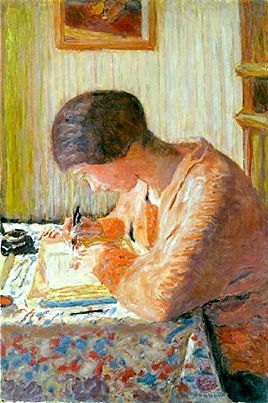
I also have a variety of home—but not kitchen—aprons meant, in actuality, to keep one clean, and cart about the aforementioned valuables. These aprons I make from thrift-store linen shirts and shifts, on which I sew trimmed cuffs and hemmed lengths for the all-important notepad-carrying pockets. This is who I am as a writer: I am never without my notepad and pen. I can easily forget these small, unassuming items, but it’s harder to overlook the bulging apron. It has become my prosthetic brain—easily detachable but increasingly necessary.
When I was a little girl, my mother sewed my first apron, and although I’ve forgotten the color and pattern, I remember the pockets. So practical. She had meticulously machined individual vertical slots for each crayon which, because I’ve always been quite forgetful, I re-filled less meticulously when done coloring. The apron also sported a couple larger pockets for Important Stuff, and a ribbon attached on one end to the apron and on the other to a pair of blunt scissors. I was ready for whatever the day brought. As I am now: I am a writer of little brain who forgets the brainstorm almost before it’s stopped thundering.
Other wardrobe items to which I’m partial are wide-brimmed straw hats (I live in the southern Utah desert of glowing redrock and burning sun); seersucker and linen shirts (heat again); the long skirts of summer (heat yet again—and bugs); tire-tread sandals; industrial-strength hand lotion; and riding boots with spurs. For I also have horses, which explains the need for the aforementioned barn aprons—horses love to wipe their considerable noses on one’s unprotected and welcoming bosom. I also love smocks, and wish I was a painter just so I could wear one.
My British-import of a mother called these practical uniforms, “pinafores,” and just so you don’t assume fluffy aprons mean sweetness and light, know that my mother was a neurotic, abusive mess—as I have been—well, I have been a cowering mess—most of my adult life. All of these things—the redrock desert and all its natural components; horses; my problematic youngsterhood; my war-scarred, disturbed mother; and her very proper Britishness inform my writing in its many manifestations from journal entries to published essays and books.
Because my aprons prevent me from dropping the phone (again) in the stock tank while cleaning it, or the irrigation ditch while watering (also again), my next foray is to create a riding apron. This will keep me from submerging the phone (in a pocket strapped to my leg) in the river while leading the recalcitrant horse, or less expensively but more importantly the notepad along the roadside (so many times I’ve lost count).
In the 1990s, while writing a book on a newly created national monument in Utah and wandering over one million remote acres, I repeatedly asked the photographer, while batting various pockets, my bra and hair (where I clipped pencils) if she had a pen. “Hey,” she’d reply, “you’re a writer, fergodsake; I don’t ask you for film.” From this you may gain two insights: I learned to carry my own pencil and paper, and I’m of a certain age.
I was born in the 1950s when real women wore aprons, and I learned to write. There is still something for me about pen and paper—the hand moving and the eyes following that urges me continue down the page. I can also write anywhere and anytime—battery and cord-less (so ecological). While acknowledging computers’ great benefit (my first editing job came before computers!), I find sitting at my desk locked in one position for days on end editing massive planning documents for the National Park Service (it pays the bills) agonizing. I realize I could join the modern age and use my phone to take notes, but I find, after speaking into a recorder, a great yawning silence (where I expect applause or at least rejoiner) that leaves me speechless.
So today, while waiting for the stock tank to fill, great and trifling ideas come unbidden, and the writer I am pulls paper and pen from my he-man apron wiped with immense muddy noses, and captures fleeting thoughts under southern Utah’s embracing redrock cliffs beside the river’s spring-smooth flow. Because that’s what writers do.
Here is an exchange between the Global Editor of the Atlantic Magazine and myself this afternoon attempting to solicit my professional services for an article they sought to publish after reading my story “25 Years of Slam Dunk Diplomacy: Rodman trip comes after 25 years of basketball diplomacy between U.S. and North Korea” here http://www.nknews.org/2013/03/slam-dunk-diplomacy/ at NKNews.org
Hi there — I’m the global editor for the Atlantic, and I’m trying to reach Nate Thayer to see if he’d be interested in repurposing his recent basketball diplomacy post on our site.






 The Occasional Chair